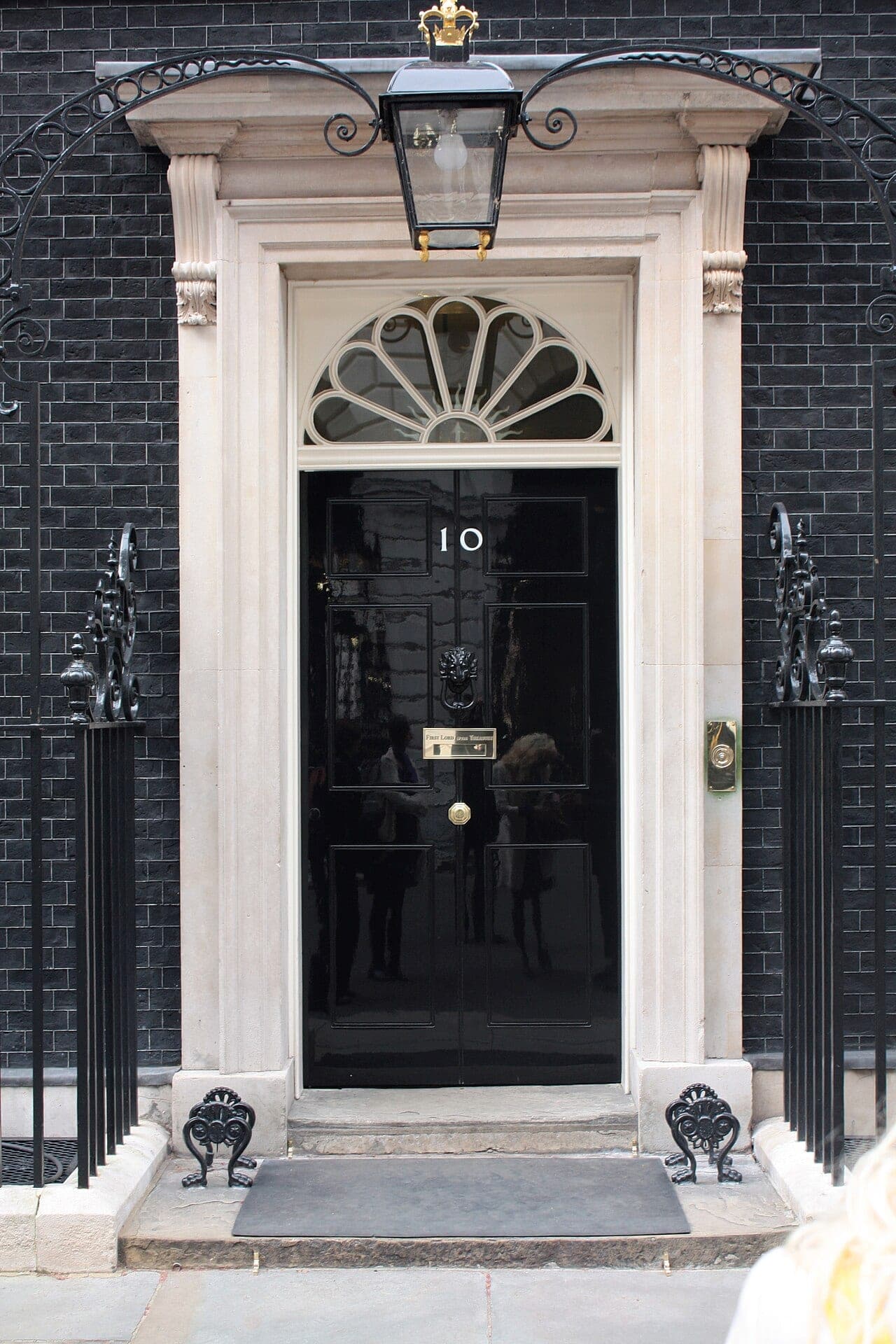
In the eight years since Britain voted to leave the European Union, the country has been led by five prime ministers — Theresa May, Boris Johnson, Liz Truss, Rishi Sunak and Keir Starmer — and a sixth, David Cameron, resigned the morning the referendum result landed. One of them, Truss, lasted fewer than 50 days, the shortest premiership in British history[2]Liz Truss“the shortest-serving prime minister in British history”. To a country that once measured its leaders in decades, it can feel like instability without precedent.
It isn't. The rapid churn of leaders is one of the oldest patterns in political history, and the thinkers who first mapped it — from the Greek historian Polybius to the present-day complexity scientist Peter Turchin — would recognise Westminster's revolving door at a glance. The useful question is the one the pattern answers: what normally happens after?
Britain's revolving door, 2016–2024
- 13 July 2016 — Theresa May succeeds David Cameron, who resigned after the Brexit referendum
- 24 July 2019 — Boris Johnson replaces May
- 6 September 2022 — Liz Truss becomes prime minister
- 25 October 2022 — Truss resigns after fewer than 50 days; Rishi Sunak takes over
- 5 July 2024 — Keir Starmer wins a landslide and enters Downing Street
Has Britain really had six prime ministers — and how unusual is it?
The official record is not in doubt. The government's own history lists the run in sequence: Cameron (2010 to 2016), May (2016 to 2019), Johnson (2019 to 2022), Truss (2022) and Sunak (2022 to 2024)[1]Past Prime Ministers, with Starmer arriving in July 2024. That is five prime ministers since the June 2016 referendum, or six if you count Cameron, who fell with it.
The Truss premiership is the exclamation mark. Appointed by Elizabeth II at Balmoral on 6 September 2022, she resigned amid a bond-market crisis on 25 October — the shortest-serving prime minister in British history[2]Liz Truss“the shortest-serving prime minister in British history”, outlasted, as the press delighted in noting, by a supermarket lettuce. Five leaders in eight years is a rate of turnover Britain had not seen since the early nineteenth century. The country's modern self-image — stable, institutional, slow to change — sits awkwardly beside the data.
What does the cycle of history actually predict?
The oldest answer comes from classical political theory. In Book VI of his Histories, Polybius set out anacyclosis: the idea that constitutions move through a fixed cycle, each good form decaying into its corrupt twin. Monarchy curdles into tyranny, aristocracy into oligarchy, and democracy into ochlocracy, or mob rule, until the resulting chaos lets a strongman seize power and the cycle begins again[3]Anacyclosis. Plato had sketched the same descent from aristocracy to tyranny in the Republic; Aristotle catalogued the stasis, the factional strife, that tips one form into the next. Their shared claim is uncomfortable for any modern democracy: instability is not an accident in the system, it is a stage of it.
Each constitution carries within it the seed of its own decay — and the chaos that follows clears the ground for one ruler to gather up what the many could not hold.
Polybius, Histories, Book VI
The modern, empirical version belongs to Turchin, whose field of "cliodynamics" runs historical data through mathematical models. In a 2010 paper in Nature, he forecast that the United States and western Europe should expect many years of political turmoil, peaking in the 2020s[4]Using Social Science to Predict the Future“We should expect many years of political turmoil, peaking in the 2020s.”. His chief driver is "elite overproduction" — an excess supply of would-be elites relative to the positions a society can offer them[5]Elite overproduction, which turns surplus aspirants into a destabilising counter-elite. Across the polities in Turchin's crisis database, the endings are sobering: around 75% concluded in revolutions or civil wars, and 60% ceased to exist altogether[5]Elite overproduction. Britain's bloodless leadership turnover is a mild symptom by that standard — but a symptom of the same underlying condition.
What happened the last times leaders fell this fast?
History gives a strikingly consistent answer to "what comes after": a consolidation of power.
Rome's Year of the Four Emperors is the textbook case. Between June 68 and December 69 AD — about thirteen months — Galba, Otho, Vitellius and finally Vespasian each claimed the throne[6]Year of the Four Emperors. The churn ended only when Vespasian won outright and founded the stable Flavian dynasty, which ruled for the rest of the century[6]Year of the Four Emperors. Two centuries later the lesson repeated, harder. During the Crisis of the Third Century (235–285 AD), more than 50 men claimed the title of emperor[7]Crisis of the Third Century in fifty years, and the near-collapse was resolved only when Diocletian restructured the imperial government into the more autocratic system known as the Dominate[7]Crisis of the Third Century. Instability bought, in the end, a stronger and less accountable executive.
The closest democratic parallel is more recent. France's Fourth Republic ran through 21 governments in just 12 years, an average of roughly seven months each[8]French Fourth Republic, its weak executive endlessly toppled by fragile coalitions. When the Algiers crisis broke the system in 1958, the country turned to Charles de Gaulle, who replaced it with a Fifth Republic built around a far stronger executive presidency[8]French Fourth Republic. The pattern holds across two millennia and three very different states: sustained churn ends with someone, or some office, gathering up the power that kept slipping away.
| Episode | The churn | What followed |
|---|---|---|
| Rome, 68–69 AD | 4 emperors in ~13 months | Vespasian's stable Flavian dynasty |
| Rome, 235–285 AD | 50+ claimants in 50 years | Diocletian's autocratic "Dominate" |
| France, 1946–1958 | 21 governments in 12 years | De Gaulle's strong-presidency Fifth Republic |
| Britain, 2016–2024 | 5–6 prime ministers in 8 years | ? |
So is Starmer Britain's Vespasian — or its de Gaulle?
Here the cyclical reading earns its keep — but honesty about where the analogy breaks matters more. Britain's churn was entirely peaceful and constitutional: no praetorian guard, no paratroopers on Corsica, no tanks. Every transfer happened by the rules, and the institutions that absorbed the shocks — the civil service, the courts, the Crown — never wobbled. The ancient cases ended in autocracy because they had no other machinery for resolving a crisis. Britain does.
That machinery may already have produced its consolidation. Starmer entered Downing Street in July 2024 not through a backroom manoeuvre but on a landslide Commons majority — the democratic equivalent of Vespasian's decisive victory or de Gaulle's mandate. A large, stable majority is precisely the instrument a parliamentary system uses to shut a revolving door. On the optimistic reading, the cycle has already turned, and the churn was the prelude to a reset rather than a slide.
And yet "this time is different" is the most over-confident sentence in politics, and usually the wrong one. The structural pressures Turchin identifies have not eased: growth remains weak, living standards have stagnated, the wealth pump that concentrates income at the top still runs, and a populist insurgency in the shape of Reform UK is tugging at both major parties. A landslide is necessary to break the cycle but not sufficient to keep it broken; majorities this size have fractured before when the underlying economics did not improve. The cyclical thesis does not forecast doom for Britain — its mature institutions are a genuine brake the ancients lacked — but it does issue a warning the optimists should sit with: the forces that produced six prime ministers in eight years are still in the room. Whether Starmer is remembered as the leader who ended the churn or merely paused it will depend less on him than on whether the pump that drives the cycle is finally switched off.