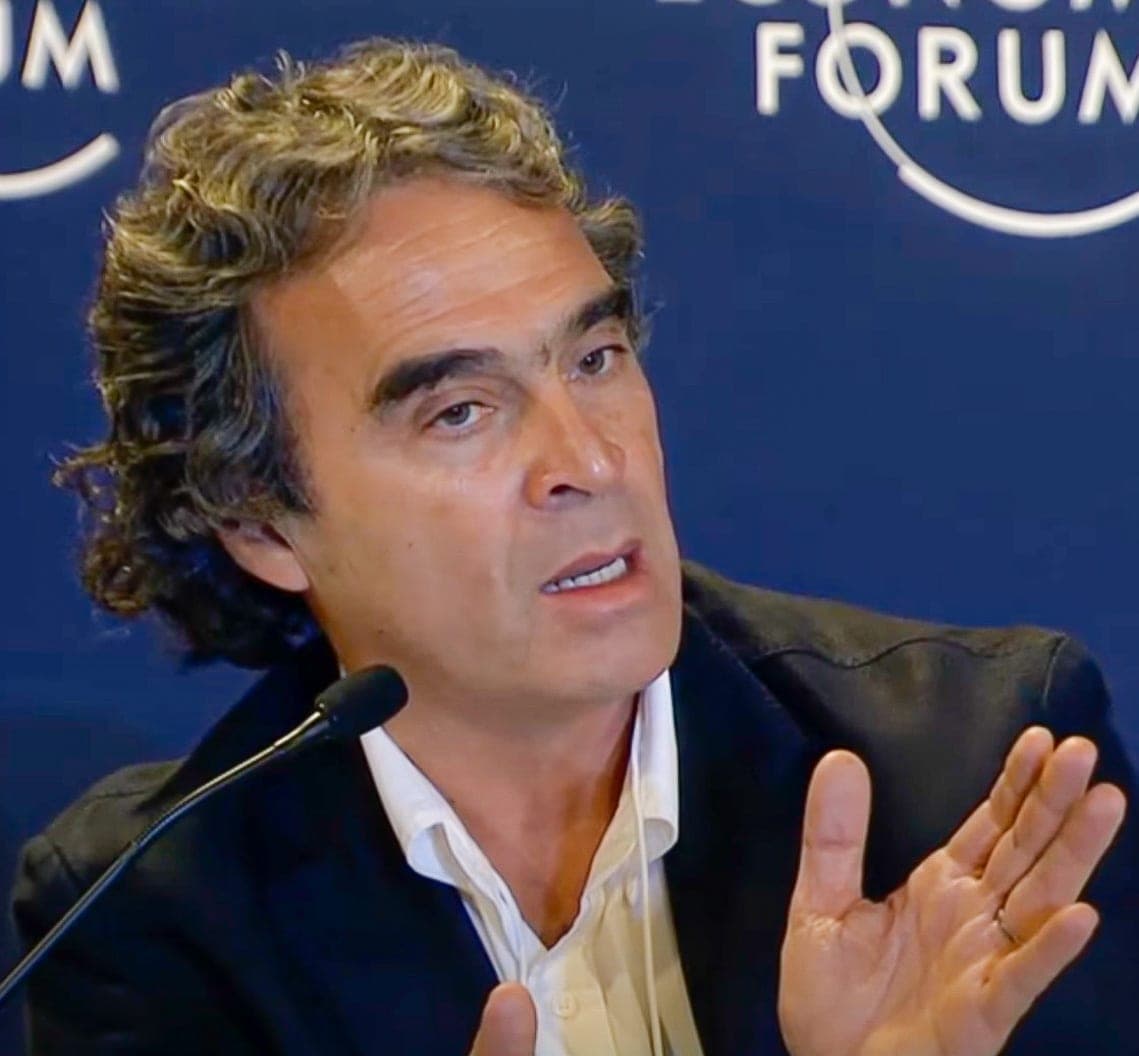
On June 3, Sergio Fajardo — the centrist former mayor of Medellín who earned over one million votes in the May 31 first round — published what he called the Decálogo del Millón de Votos: a 10-point manifesto of conditions that must be met before he would consider backing either runoff candidate. He did not mention Iván Cepeda or Abelardo de la Espriella by name. He didn't have to. Every line of the document was a bill of indictment for Gustavo Petro's four years in power — presented not by the right, but by a left-of-centre politician who once championed education reform and peaceful politics.
Read the conditions. Fajardo demanded "explicit and unrestricted respect for institutional balance and the independence of powers" — then added pointedly that this is "incompatible with persistent challenges to our 1991 Constitution and even less so with attempts to undermine or change it through a Constituent Assembly," according to Vanguardia's full reporting on the manifesto. He demanded an end to Total Peace. He demanded a "rigorous audit of the current administration" for corruption. He demanded a foreign policy stripped of "personal feuds, improvisation, or ideological affinities." That is the Petro government's record, rendered in negative.
A Manifesto That Maps Failure
No Constituent Assembly. Petro signed a formal constituent assembly petition at a livestreamed Cabinet meeting in February 2026, targeting 2.5 million signatures for submission to the incoming Congress on July 20. Cepeda initially supported the push, then spent the final campaign weeks walking it back — with his campaign chief María José Pizarro telling Blu Radio, in terms reported by Infobae Colombia: "We are not pushing a constituent assembly." The retreat fooled no one. Law professor Fabio Pulido of Universidad de La Sabana, interviewed by Infobae, described the shift bluntly: Petro's camp "thought it was a topic that would give them votes — and now realized it doesn't." Pulido added that legally, "they don't have the political force or majorities" for a legitimate assembly; what remains is only "the threat of an irregular constituent assembly." Fajardo's second condition forecloses exactly that threat.
End Total Peace. Colombia's armed group combatant count now exceeds 25,000, up approximately 85% since 2017. The ELN talks collapsed after the January 2025 Catatumbo massacre. The main FARC dissident faction (EMC) broke off negotiations. Colombia remains the world's largest cocaine producer. These are the measurable outcomes of a peace policy that prioritised dialogue over deterrence and achieved neither. Fajardo's call for "recovering control of territory" and "confronting illegal economies" is not a hawk's overreach — it is the minimum requirement of a country that watched its violence statistics worsen across four years of promised transformation.
Audit the Petro Administration. Former Finance Minister Ricardo Bonilla and former Interior Minister Luis Fernando Velasco went to trial before Colombia's Supreme Court in late April 2026, charged with leading a criminal network that steered approximately $161 million in contracts to buy congressional votes for Petro's legislative agenda, according to ColombiaOne's reporting on the trial's opening session. Former Senate president Iván Name and former House president Andrés Calle are in prison. A former presidential intelligence chief is a fugitive in Nicaragua. An El Tiempo investigation revealed roughly 31 trillion pesos — approximately $8.5 billion USD — in direct contracts awarded without competitive bidding. Fajardo is not calling for scrutiny of an opponent. He is calling for accountability for the government his own voters watched implode.
Professional Foreign Policy. Petro spent four years picking diplomatic fights with neighbours, enduring counternarcotics sanctions from the Trump administration, and leaving Colombia without a resident U.S. ambassador for the entire duration of his presidency. The "personal feuds and ideological affinities" that Fajardo decries are not abstractions — they are the traceable decisions of a foreign policy conducted as personal theatre, with consequences for trade, aid, and security cooperation.
The Math Is Merciless
Here is what makes the Decálogo most politically devastating: even if Cepeda agreed to every single one of Fajardo's conditions, the arithmetic of June 21 does not change.
The first post-first-round poll, conducted by Atlas Intel for Semana magazine — the firm whose projections came closest to the May 31 result — shows De la Espriella at 50.3% against Cepeda's 42.6%, as reported by ColombiaOne. Among Fajardo's own voters, only 24.2% say they would support Cepeda in the runoff; 43.6% plan to cast a blank ballot, and 18.9% say they would back De la Espriella.
La Silla Vacía, Colombia's most rigorous electoral analysis outlet, produced a projection concluding that "even if 100% of centrist votes — represented by Fajardo and Claudia López — were transferred to Cepeda, and only 50% of Paloma Valencia's voters backed De la Espriella, the left-wing candidate would still fail to surpass the far-right contender," as reported by ColombiaOne on June 3. The projection is the most damning single mathematical fact of the runoff campaign and has received almost no attention in English-language coverage.
The structural problem is irreversible: De la Espriella's first-round total of 10,361,499 votes was achieved without a major party machine. His coalition has since consolidated to include the Conservative Party, Cambio Radical, Centro Democrático, Partido de la U, and Paloma Valencia's 1.6 million votes. Cepeda, by contrast, cannot grow beyond a left-wing base whose ceiling is constrained by the Petro government's 56.7% disapproval rating measured in pre-election polling.
What the Silence Reveals
As of June 3 evening, neither Cepeda nor De la Espriella had publicly responded to Fajardo's conditions, according to Infobae Colombia. That silence is itself a statement. Cepeda cannot credibly accept the anti-constituent-assembly conditions without repudiating his president. He cannot accept the anti-Total-Peace conditions without abandoning the most distinctive policy of the movement he represents. He cannot accept the audit conditions without calling for scrutiny of allies and comrades. He cannot, in short, become what Fajardo demands without ceasing to be Petrismo's candidate.
Meanwhile, Juan Daniel Oviedo — Paloma Valencia's moderate running mate — announced on June 3 that he would not endorse either candidate. His pointed statement that "this country doesn't deserve a government that ignores electoral results," as reported by Vanguardia, delivered an unmistakable implicit criticism of Petro's still-active fraud narrative — a narrative that the National Registrar, the EU Election Observation Mission, the OAS, Colombia's Supreme Court, and the Council of the Judicature have all refuted, and that even Cepeda's own campaign walked back on June 1.
Four years of promised transformation. A constituent assembly that never materialised. A peace process that empowered armed groups. A corruption trial that placed two cabinet ministers in the dock. A fraud narrative that even the ruling party's own candidate quietly abandoned. Fajardo's manifesto did not invent these failures. It simply catalogued them. The Colombian centre has issued its assessment — and Petrismo has no adequate reply.