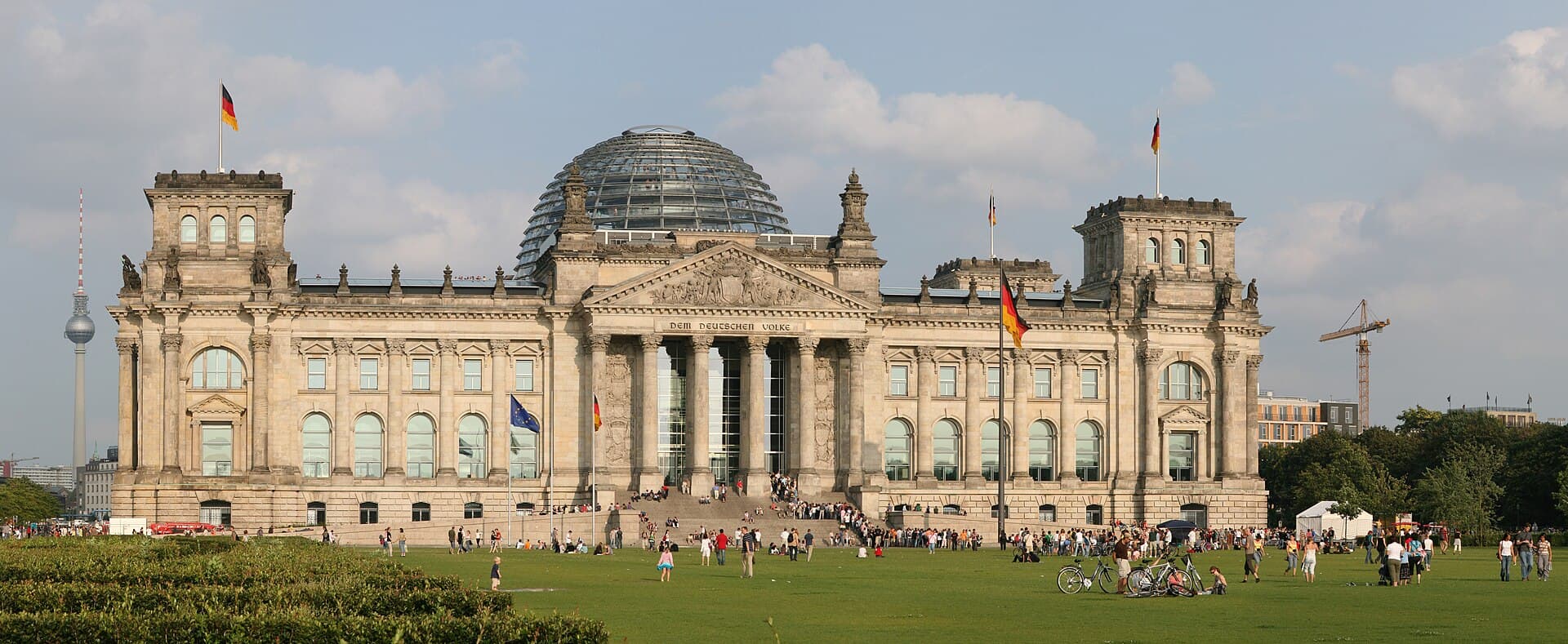
The Brandmauer — the firewall — was supposed to hold.
In June 2026, Germany's governing coalition of the CDU/CSU and SPD is polling at just 34.6% combined support[2]AfD Polls Record 28% as Lead on Union Widens“Governing 'black-red' coalition parties would reach only 34%; 53% said no party is capable of effectively addressing Germany's problems; 121 of 183 recorded violent crimes against politicians targeted AfD representatives” according to Forsa survey data, with 69% of Germans rating the government's work as 'rather poor' and Chancellor Friedrich Merz carrying a 71% disapproval rating[1]Germany Election Polls & Voting Intentions 2026“AfD at 27.9% (June 22, 2026), up +7.1 pp since February 2025 election; governing coalition at 39.5% of seats; 69% rate government poorly; 71% Merz disapproval; majority of Germans see Brandmauer as 'either useless or even beneficial for the AfD'”. The Alternative for Germany — which every major party has categorically pledged never to include in any coalition at any level of government — now stands at 27.9% in national polls, seven points above its February 2025 federal election result of 20.8%[1]Germany Election Polls & Voting Intentions 2026“AfD at 27.9% (June 22, 2026), up +7.1 pp since February 2025 election; governing coalition at 39.5% of seats; 69% rate government poorly; 71% Merz disapproval; majority of Germans see Brandmauer as 'either useless or even beneficial for the AfD'”. It is the single most popular party in the country.
More striking is what ordinary Germans believe about the exclusion strategy itself. According to PolitPro's June 2026 political analysis[1]Germany Election Polls & Voting Intentions 2026“AfD at 27.9% (June 22, 2026), up +7.1 pp since February 2025 election; governing coalition at 39.5% of seats; 69% rate government poorly; 71% Merz disapproval; majority of Germans see Brandmauer as 'either useless or even beneficial for the AfD'”, a majority of Germans perceive the established parties' containment strategy as 'either useless or even beneficial for the AfD.' The Brandmauer is not simply failing to contain the movement. German public opinion has concluded it is feeding it.
Three thousand years of political theory could have told Berlin why.
Why Does Polybius's Anacyclosis Apply Directly Here?
Polybius, the Greek historian who observed Rome at its constitutional zenith and theorized its decay in Histories Book VI, identified anacyclosis — the rotation of constitutions — as driven not by any single event but by a specific structural dynamic. The terminal phase of democracy arrives when the established political classes harden into a defensive coalition whose only shared mission is mutual protection against an emergent popular challenger. The coalition is held together not by positive governing purpose but by shared exclusion. Meanwhile, the challenger's internal group solidarity intensifies precisely through the experience of persecution.
Polybius traced this in Histories Book VI.57: democracy degenerates when institutional constraint is replaced by factional interest. What the Gracchi-to-Caesar sequence — 133 to 49 BCE — illustrated is that attempted suppression of the popular champion typically accelerates rather than reverses the process.
Ibn Khaldun's Muqaddimah (Book II) supplies the mechanism at the social level: he calls it asabiyyah — the binding group cohesion that makes a movement politically formidable. The ruling establishment loses its own asabiyyah in exact proportion to losing its positive governing purpose. Germany's coalition is exhibiting textbook symptoms. Within Merz's first 100 days, CDU/CSU legislators refused to support the SPD's nominee for a Constitutional Court vacancy; SPD ministers publicly called the move 'a serious breach of trust' — a rupture political analysts described as one of the biggest obstacles to governing[7]Merz's Germany: Inexperience, coalition crisis, growing AfD threat“Conservative MPs from Merz's CDU/CSU refused to support the SPD's candidate for Constitutional Court judge; SPD called this a 'serious breach of trust'; commentary suggests the government is already 'exhausted' only 100 days after taking office”. The governing asabiyyah is dissolving while the AfD's deepens.
Germany's Political Moment — By the Numbers
- 27.9%: AfD national poll share — Germany's most popular party (PolitPro, June 22, 2026)
- +7.1 pp: AfD's gain since its 20.8% result in the February 2025 election
- 34.6%: CDU/CSU + SPD combined poll share (Forsa, May 2026) — below a parliamentary majority
- 71%: Germans disapproving of the Merz government (PolitPro, May 2026)
- 53%: Germans saying no party can effectively address their country's problems (Forsa, May 2026)
- 121 of 183: Recorded violent crimes against politicians that targeted AfD representatives
What Does Germany's Economic Substrate Reveal?
Neither Polybius nor Ibn Khaldun believed political cycles ran on ideology alone. They run on economic substrate. Germany's is unfavorable in a historically specific way. German GDP contracted 0.9% in 2023 and 0.5% in 2024, making it the worst-performing major economy globally for two consecutive years[4]German economic crisis (2022–present)“Germany became the worst-performing major economy globally in 2023 with a 0.9% contraction, followed by further 0.5% contraction in 2024; output remained at approximately 2019 level in 2024”; output remains essentially flat against 2019 levels. Real wages, per the OECD's 2025 Employment Outlook, remain 0.2% below their early-2021 level[5]OECD Employment Outlook 2025: Germany“In Germany, nominal wages have increased by 2.7% between Q1 2024 and Q1 2025. While real wages have grown by 0.4% over this period, they remain 0.2% below the Q1 2021 level”. The European Commission projects real wage growth will slow sharply in 2026 as inflation spikes to 2.9%[6]Economic forecast for Germany — European Commission“With inflation spiking in 2026, real wage growth is set to slow sharply; HICP inflation is projected to spike to 2.9% in 2026; deficit expected to increase to 3.7% and 4.1% of GDP driven by higher defence spending”. Meanwhile, global public debt has risen to just under 94% of GDP in 2025 and is set to reach 100% by 2029[8]Fiscal Monitor April 2026: Fiscal Policy under Pressure: High Debt, Rising Risks“Global public debt rose to just under 94 percent of GDP in 2025 and is set to reach 100 percent by 2029, one year earlier than projected in April 2025”, according to the IMF's April 2026 Fiscal Monitor, with Germany's own deficit projected to widen to 4.1%[6]Economic forecast for Germany — European Commission“With inflation spiking in 2026, real wage growth is set to slow sharply; HICP inflation is projected to spike to 2.9% in 2026; deficit expected to increase to 3.7% and 4.1% of GDP driven by higher defence spending” of GDP driven by higher defense spending.
Peter Turchin's structural-demographic theory, which correctly forecast growing Western instability in his 2010 papers, identifies three concurrent drivers of political crisis: popular immiseration, elite overproduction, and state fiscal fragility. Germany exhibits all three. The structural conditions generating AfD's growth are not being addressed by the governing strategy; they are being managed rhetorically while compounding empirically.
Isn't Modern Germany's Architecture Different? — The Counterargument, Honestly Stated
The strongest rebuttal must be stated plainly: modern Germany is not the Weimar Republic. The 1949 Basic Law corrected Weimar's structural defects with deliberate precision — Article 79(3)'s eternity clauses make the constitutional core unamendable by any majority. The Federal Constitutional Court exercises genuine independence. EU membership and NATO collective defense remove the national humiliation and military collapse that made voters receptive to authoritarian remedies in 1930-33. Germany's democratic culture, shaped by 80 years of reckoning with the Nazi period, provides normative ballast that Weimar entirely lacked.
These guardrails are real and should not be dismissed. The cyclical thesis does not predict mechanical repetition; it predicts that identical structural pressures produce recognizable family resemblances in political outcomes.
But one prediction is empirically testable right now: exclusionary strategies do not suppress the excluded movement — they intensify its internal solidarity. The BfV classified AfD as a 'confirmed right-wing extremist endeavor' in May 2025 — a 1,100-page designation that subjects the party to expanded surveillance and could precede a legal ban attempt[3]Alternative for Germany“In May 2025, BfV classified AfD as 'confirmed right-wing extremist endeavor' in a 1,100-page report; Friedrich Merz warned 'banning parties has never actually solved political problems'”. In the 16 months since that classification, AfD's poll share has risen 7.1 percentage points. The Brandmauer's failure is not theoretical. It is observable, week by week, in the polling data.
Banning parties has never actually solved political problems.
Friedrich Merz, CDU leader, on proposals to ban the AfD
What Did Machiavelli Warn About Permanent Political Exclusion?
In the Discourses on Livy, Machiavelli's analysis of republican resilience turns on a premise: a republic endures when every significant faction has more to gain from its preservation than from its destruction. The Brandmauer, if it hardens indefinitely, confronts this premise directly. At 27.9% national support[1]Germany Election Polls & Voting Intentions 2026“AfD at 27.9% (June 22, 2026), up +7.1 pp since February 2025 election; governing coalition at 39.5% of seats; 69% rate government poorly; 71% Merz disapproval; majority of Germans see Brandmauer as 'either useless or even beneficial for the AfD'” — designated extremist, surveilled by intelligence services, potentially subject to a legal ban — the AfD's constituency faces a narrowing set of options within the existing constitutional order.
The historical cases where this question was posed and left unanswered — the Roman optimates against the populares (133–49 BCE), the French Third Republic's establishment against the Leagues in the 1930s — resolved in ways the excluding establishment did not anticipate. Aristotle, in Politics Book V.1, identified the mechanism: each individually defensible exclusionary step adds to the accumulated weight of structural discontent until that weight becomes transformative.
Where Is This Trajectory Leading?
Polybius's anacyclosis does not predict a Nazi recurrence — the institutional landscape is categorically different. It predicts something more specific: when a governing establishment is structurally unable to address the conditions generating popular discontent and substitutes exclusion for problem-solving, the pressure will find expression at the next available stress point.
In Germany, that stress point arrives in approximately 76 days: the Saxony-Anhalt state election, where AfD polls at roughly 39-40% — nearly 15 points ahead of the CDU — and where the party could produce Germany's first AfD minister-president[1]Germany Election Polls & Voting Intentions 2026“AfD at 27.9% (June 22, 2026), up +7.1 pp since February 2025 election; governing coalition at 39.5% of seats; 69% rate government poorly; 71% Merz disapproval; majority of Germans see Brandmauer as 'either useless or even beneficial for the AfD'”. If the Brandmauer holds there through a fragile multi-party coalition, Aristotle's pattern of accumulated small exclusions will have cleared another checkpoint. If it breaks, a structural threshold will have been crossed.
Merz himself said banning parties never solved political problems[3]Alternative for Germany“In May 2025, BfV classified AfD as 'confirmed right-wing extremist endeavor' in a 1,100-page report; Friedrich Merz warned 'banning parties has never actually solved political problems'”. Polybius mapped how governing coalitions held together only by mutual exclusion eventually lose the capacity to govern at all. The open question — the one that Germany's genuine institutional strengths make genuinely open, unlike any prior historical case — is whether its constitutional architecture is strong enough to survive the accumulation of that pressure long enough for the structural-demographic conditions to change. Based on the evidence of June 2026, the gap between what the Brandmauer strategy is delivering and what Germany's underlying conditions require is still widening.