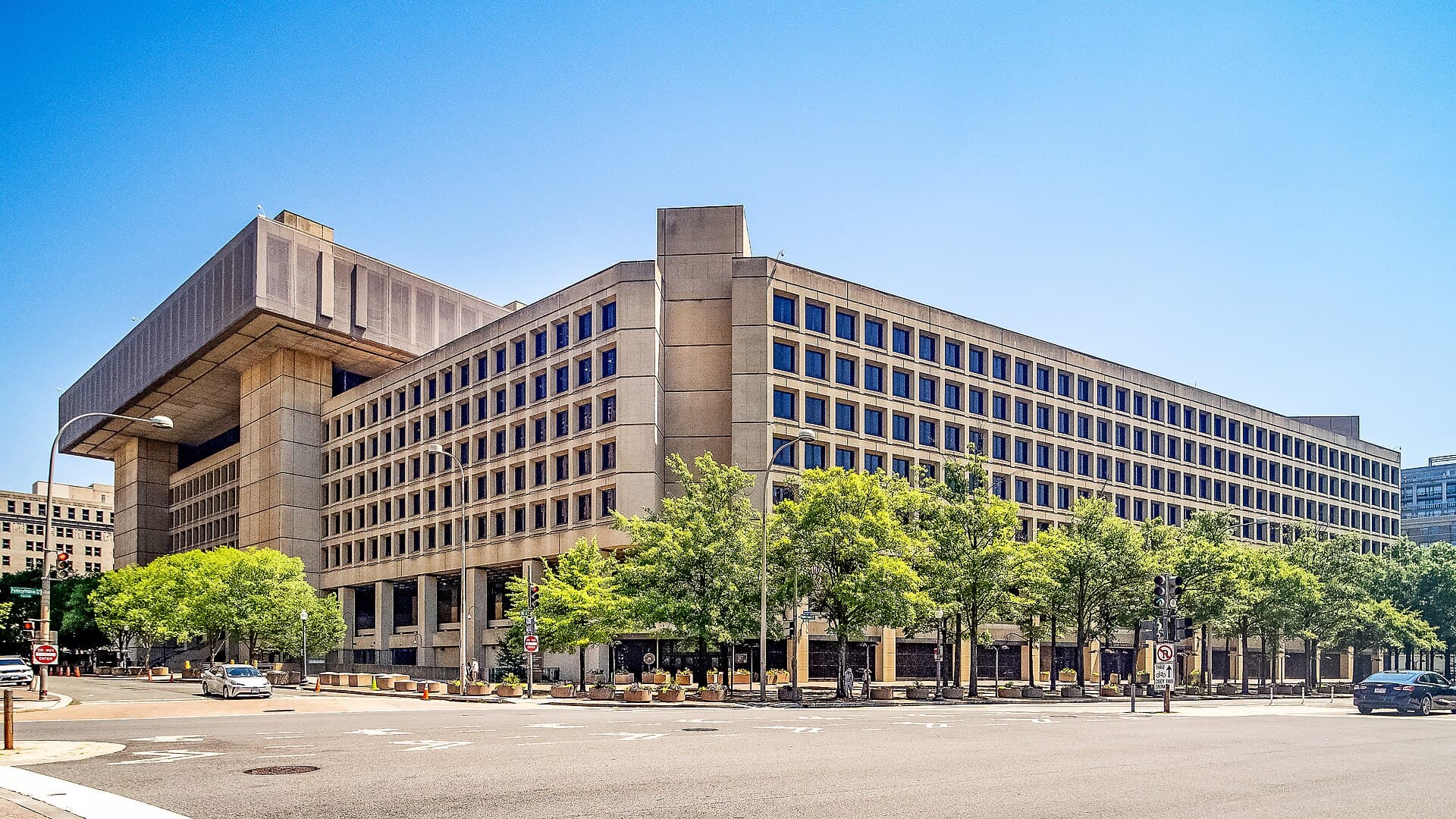
A Thursday Morning in Cleveland
On June 11, 2026, a Thursday, FBI agents arrived at the Cleveland offices of the Ohio Organizing Collaborative — a nonprofit voter-registration group founded in 2007 — and spent hours questioning staff, seizing electronic devices, and then fanning out across the state to visit the homes of volunteers and community organizers[1]FBI searches office of Ohio group that supports voter registration efforts“FBI agents fanned out across Ohio, showing up at the homes of group leaders and staff, and raided the Cleveland office of the Ohio Organizing Collaborative; the Justice Department also seized election records from Fulton County GA, Maricopa County AZ, Wayne County MI, and questioned workers in Milwaukee County WI.”, pressing them at their doorsteps, according to board member Prentiss Haney, about alleged voter fraud. The FBI and the Justice Department declined to explain publicly what the investigation was about.
Haney called it "straight-up intimidation tactics." Ohio's Democratic gubernatorial nominee, Amy Acton, said she was "deeply troubled." The Brennan Center for Justice[3]The SAVE Act and the Election Power Grab“The Brennan Center estimates 21 million Americans lack ready access to documents required by the SAVE America Act; more than 160 filibuster exceptions have been created since 1969, and more than half of all cloture votes have occurred in the last 12 years.” called it "a clear abuse of power." Ohio Republicans said little. Neither side disputed the basic facts.
The raid was the latest in a series. The Justice Department has seized ballots and election records from Fulton County, Georgia; Maricopa County, Arizona; Wayne County, Michigan; and questioned election workers in Milwaukee County, Wisconsin — all four presidential battleground states[1]FBI searches office of Ohio group that supports voter registration efforts“FBI agents fanned out across Ohio, showing up at the homes of group leaders and staff, and raided the Cleveland office of the Ohio Organizing Collaborative; the Justice Department also seized election records from Fulton County GA, Maricopa County AZ, Wayne County MI, and questioned workers in Milwaukee County WI.”. It has also sued at least 30 states and the District of Columbia after they refused to hand over detailed voter data including dates of birth and partial Social Security numbers[1]FBI searches office of Ohio group that supports voter registration efforts“FBI agents fanned out across Ohio, showing up at the homes of group leaders and staff, and raided the Cleveland office of the Ohio Organizing Collaborative; the Justice Department also seized election records from Fulton County GA, Maricopa County AZ, Wayne County MI, and questioned workers in Milwaukee County WI.”.
This essay is not primarily about the FBI. It is about a pattern. And the pattern — the systematic weaponization of legal and institutional mechanisms against electoral infrastructure before a pivotal election — has a long and well-documented history. Two and a half millennia of political thinkers mapped it with precision. They named it, explained its mechanism, identified its trajectory, and predicted where it leads. Their model is not comfortable reading.
What Aristotle Actually Said About Election Intrigue
The standard treatment of Aristotle's Politics Book V focuses on the opening chapters: the argument that stasis — civil conflict — arises from perceptions of injustice, from relative deprivation, from inequality of wealth or honor. These passages have generated an enormous secondary literature, and rightly so.
But Aristotle's most operationally specific observation in Book V is less often cited. In V.3, he writes, in the translation of the Perseus Digital Library[9]Aristotle, Politics Book V“Aristotle: 'revolutions in constitutions take place even without factious strife, owing to election intrigue.'”, that "revolutions in constitutions take place even without factious strife, owing to election intrigue"[9]Aristotle, Politics Book V“Aristotle: 'revolutions in constitutions take place even without factious strife, owing to election intrigue.'” — and he gives a precise ancient example. At Heraea, in Arcadia, electoral corruption became so severe and so normalized that the city switched from popular election of magistrates to selection by lot. The people did this specifically because, as Aristotle records, aspirants for office had learned to "get hold of the people[10]Politics of Aristotle Book V“Aristotle: 'the aspirants for office get hold of the people, and contrive at last even to set them above the laws.'”" and game the electoral system. The solution — randomization of selection — was a structural admission of defeat: the electoral mechanism itself had been corrupted beyond repair.
Aristotle then makes his most disturbing observation about democracy's terminal stage. In his own voice, drawing on Athens and multiple other case studies, he writes in Book V that the demagogue's final move is to go beyond manipulating elections within the existing framework to using the people as a weapon against the framework itself: "the aspirants for office get hold of the people, and contrive at last even to set them above the laws"[10]Politics of Aristotle Book V“Aristotle: 'the aspirants for office get hold of the people, and contrive at last even to set them above the laws.'”.
Notice the sequence. First, aspirants manipulate electoral procedures. Then, having cultivated a popular following through this manipulation, they use that following to override the constitutional order. The mob does not spontaneously arise to overthrow law; the mob is cultivated, step by step, through electoral manipulation.
Among the 11 causes of constitutional change that Aristotle catalogs in Book V — which include insolence, fear, disproportionate increase of power, and contempt — "corrupt election procedures" appears specifically as the mechanism that produces constitutional change without open civil war. This is his most prescient observation, and it is the least cited. Constitutional democracies do not always die in coups. Aristotle knew that they more commonly die in escalating cycles of electoral manipulation that progressively destroy the legitimacy of elections as a mechanism for peaceful power transfer.
Polybius's More Precise Map
Aristotle was Polybius's primary intellectual influence, but Polybius sharpened the analysis in two important ways. Writing in the second century BCE — close enough to Rome's experience to observe the Republic's mixed constitution in action — Polybius named the degenerate form of democracy with explicit precision: ochlocracy, mob rule. And in Histories Book VI, he identified the specific transition mechanism: "in due course the licence and lawlessness of this form of government produces mob-rule to complete the series"[8]Polybius, Histories Book VI“Polybius: 'in due course the licence and lawlessness of this form of government produces mob-rule to complete the series.'”.
The anacyclosis — the constitutional cycle — is Polybius's most famous contribution to political theory. Each of the three legitimate forms of government (monarchy, aristocracy, democracy) degenerates over time into its corrupt counterpart (tyranny, oligarchy, ochlocracy), from which the cycle begins again. The mechanism of each transition is the same: the ruling element places its factional interests above the constitutional framework.
For democracy's transition to ochlocracy, Polybius is specific: "the people of the state will become corrupted, and will develop a sense of entitlement and will be conditioned to accept the pandering of demagogues"[12]Anacyclosis“Polybius's anacyclosis: 'the people of the state will become corrupted, and will develop a sense of entitlement and will be conditioned to accept the pandering of demagogues.'”. The demagogue does not seize power in a single dramatic moment. The demagogue cultivates a constituency by progressively normalizing the idea that the constitutional framework is an obstacle rather than a guarantee — that my faction's circumventing of procedural norms is legitimate because the other faction is worse.
in due course the licence and lawlessness of this form of government produces mob-rule to complete the series.
Polybius, *Histories* Book VI, c.150 BCE
Polybius believed Rome's mixed constitution — combining consular authority (monarchical), Senate power (aristocratic), and popular assemblies (democratic) — was uniquely stabilized against this cycle precisely because each element could check the others. His insight was structural: the decay of a democracy into ochlocracy is not the result of a sudden decision by anyone but of the accumulated weight of many smaller decisions, each individually defensible, that collectively erode the mutual constraint that makes elections meaningful.
He was watching the Roman Republic at the height of its power when he wrote this. He died around 118 BCE. Twenty years after his death, Gaius Gracchus was killed. Thirty years after that, the Marius-Sulla crisis began. Within a century of Polybius's death, Caesar crossed the Rubicon.
The Roman Ambitus Ratchet
The Latin word ambitus — the root of the English "ambition" — originally meant canvassing for votes, the legitimate courtship of the citizenry. Over the course of the Roman Republic's late period, it acquired an exclusively pejorative meaning: electoral corruption, vote-buying, and the manipulation of voting procedures for factional advantage.
The Republic enacted at least 11 separate leges ambitus — electoral corruption laws — between 432 BCE and Caesar's dictatorship. Each was a response to the previous generation's innovations in electoral manipulation. Each one was, individually, a reasonable institutional reform. Collectively, they charted an accelerating decline: each law was a marker of how much more creative and systematic the manipulation had become.
The critical turning point was 88 BCE. The tribune Publius Sulpicius Rufus struck a deal with the general Gaius Marius: Sulpicius would propose legislation stripping Sulla's military command and reassigning it to Marius, and in return Marius's veterans would ensure the law passed in the popular assembly — using the threat of violence to guarantee the electoral outcome[11]Crisis of the Roman Republic“Historian Harriet Flower: 'Sulpicius decided to throw republican norms aside in his bid to control the political scene in Rome'; Cinna 'dominated domestic Roman politics, controlling elections and other parts of civil life.'”. When the vote went through, Sulla responded by marching his legions on Rome. As historian Harriet Flower wrote: "Sulpicius decided to throw republican norms aside in his bid to control the political scene in Rome"[11]Crisis of the Roman Republic“Historian Harriet Flower: 'Sulpicius decided to throw republican norms aside in his bid to control the political scene in Rome'; Cinna 'dominated domestic Roman politics, controlling elections and other parts of civil life.'” — and Sulla then matched the escalation.
The next phase was worse. When Cinna and his partisans controlled Rome in Sulla's absence, "Cinna dominated domestic Roman politics, controlling elections and other parts of civil life" — conducting his own purge of political opponents and winning the consulship three years in a row[11]Crisis of the Roman Republic“Historian Harriet Flower: 'Sulpicius decided to throw republican norms aside in his bid to control the political scene in Rome'; Cinna 'dominated domestic Roman politics, controlling elections and other parts of civil life.'”. Sulla's eventual return produced his own program: proscriptions, constitutional reforms imposed by force, and — crucially — a doubling of the Senate's membership specifically designed to dilute the influence of any individual senator. This was gerrymandering by other means: restructuring the composition of the legislature to entrench factional advantage.
The pattern the ancients identified was not the explosion of violence. It was the ratchet. Each step made the next step both more likely and more justified, in the eyes of the faction taking it. Polybius's constitutional framework specifically predicted that once one element of the mixed constitution began treating the electoral process as terrain to be captured, the others would follow — and the result would be the progressive destruction of elections as a mechanism for legitimate power transfer.
Rome's Electoral Manipulation Ratchet, 133–49 BCE
- 133 BCE — Senate kills Tiberius Gracchus without trial; precedent of using lethal force against elected tribune established
- 122 BCE — Senate manipulates procedure to obstruct Gaius Gracchus's re-election
- 88 BCE — Marius uses tribune Sulpicius to manipulate assembly to transfer Sulla's military command; Sulla marches legions on Rome
- 87–84 BCE — Cinna "controls elections and civil life"; wins consulship three consecutive years through intimidation
- 82 BCE — Sulla's proscriptions: first mass political assassinations backed by lists published in public
- 67–60 BCE — Pompey, Crassus, Caesar compete for electoral advantage through increasingly aggressive factional alliances
- 49 BCE — Caesar crosses the Rubicon; Republic effectively ends
The 2026 Pattern: What the Data Actually Shows
With 145 days remaining until the November 3, 2026 midterm elections — the first federal election in the United States during V-Dem's autocratization window — the following pattern has emerged:
The redistricting arms race. Before 2025, only two states had conducted voluntary mid-decade redistricting since 1970[5]The Redistricting Arms Race“Before 2025, only two states had conducted voluntary mid-decade redistricting since 1970; six states enacted new congressional maps between the 2024 and 2026 elections.”. Between 2024 and 2026, six states — California, Missouri, North Carolina, Ohio, Texas, and Utah — enacted new congressional maps outside the normal post-census cycle. According to Harvard Kennedy School[4]Explainer: What's happening with gerrymandering in the United States — and who will 'win' the redistricting battle?“Professor Ben Schneer: 'more than a quarter of all congressional seats have already been redrawn mid-decade as part of this back and forth'; Texas's redistricting 'set off a race to the bottom.'” professor of public policy Benjamin Schneer, "more than a quarter of all congressional seats have already been redrawn mid-decade as part of this back and forth"[4]Explainer: What's happening with gerrymandering in the United States — and who will 'win' the redistricting battle?“Professor Ben Schneer: 'more than a quarter of all congressional seats have already been redrawn mid-decade as part of this back and forth'; Texas's redistricting 'set off a race to the bottom.'” — the highest rate of mid-decade redistricting since the 19th century.
The trigger was President Trump's pressure on Texas to redraw its congressional districts in the summer of 2025, explicitly to add five Republican seats ahead of the midterms[4]Explainer: What's happening with gerrymandering in the United States — and who will 'win' the redistricting battle?“Professor Ben Schneer: 'more than a quarter of all congressional seats have already been redrawn mid-decade as part of this back and forth'; Texas's redistricting 'set off a race to the bottom.'”. California then bypassed its own independent redistricting commission — which the state had created specifically to prevent partisan manipulation — via a ballot measure, and drew a map aimed to increase Democratic seats from 41 to 47[17]State Redistricting Legal Challenges Intensify Ahead of 2026 Elections“California's new map aimed to increase Democratic seats from 41 to 47; six states enacted new maps between 2024 and 2026 elections.”. Florida, Virginia, North Carolina, and other states followed. The Supreme Court's ruling in Louisiana v. Callais, which significantly narrowed Section 2 of the Voting Rights Act's protections, accelerated the process further.
"What was maybe unanticipated," Professor Schneer told Harvard Kennedy School's publications, "is that this set off a 'race to the bottom,' where many other states took this precedent set by Texas as a signal that they, too, should redraw their maps mid-decade"[4]Explainer: What's happening with gerrymandering in the United States — and who will 'win' the redistricting battle?“Professor Ben Schneer: 'more than a quarter of all congressional seats have already been redrawn mid-decade as part of this back and forth'; Texas's redistricting 'set off a race to the bottom.'”. California even eliminated its own independent redistricting safeguard to join the race.
The SAVE America Act. In February 2026, the House passed the SAVE America Act — the Safeguard American Voter Eligibility Act — on a near-party-line vote. The Brennan Center for Justice estimated that the bill's requirement to present a passport or birth certificate in person to register to vote would have blocked approximately 21 million eligible American citizens from voting[3]The SAVE Act and the Election Power Grab“The Brennan Center estimates 21 million Americans lack ready access to documents required by the SAVE America Act; more than 160 filibuster exceptions have been created since 1969, and more than half of all cloture votes have occurred in the last 12 years.”. The bill failed in the Senate on June 4, 2026, blocked by a filibuster that required four Republicans to join Democrats in opposition[2]SAVE Act, Republicans' voting overhaul, fails in the Senate“The SAVE America Act failed in the Senate on June 4, 2026; Notre Dame law professor Derek Muller said the bill would have been 'among the most significant nationalizations of elections in American history.'”.
Senator Mike Lee of Utah explicitly connected the bill's passage to Republican prospects in the 2026 midterm elections[14]The SAVE Act: What every American Voter Needs to Know“Senator Mike Lee 'publicly connected the bill's passage to Republican prospects in the 2026 midterm elections.'”, posting a prediction market chart showing Democrats favored to win Senate control. University of Notre Dame law professor Derek Muller, cited by NPR[2]SAVE Act, Republicans' voting overhaul, fails in the Senate“The SAVE America Act failed in the Senate on June 4, 2026; Notre Dame law professor Derek Muller said the bill would have been 'among the most significant nationalizations of elections in American history.'”, observed that the SAVE America Act would have been "among the most significant nationalizations of elections in American history"[2]SAVE Act, Republicans' voting overhaul, fails in the Senate“The SAVE America Act failed in the Senate on June 4, 2026; Notre Dame law professor Derek Muller said the bill would have been 'among the most significant nationalizations of elections in American history.'” and wrote that "the debate has shifted from whether to nationalize elections to how."
Federal election infrastructure raids. The Ohio Organizing Collaborative raid was not isolated. The Justice Department has seized ballots from Fulton County, Georgia; Maricopa County, Arizona; and Wayne County, Michigan; and questioned election workers in Milwaukee County, Wisconsin — all four presidential battleground states from the 2024 election[1]FBI searches office of Ohio group that supports voter registration efforts“FBI agents fanned out across Ohio, showing up at the homes of group leaders and staff, and raided the Cleveland office of the Ohio Organizing Collaborative; the Justice Department also seized election records from Fulton County GA, Maricopa County AZ, Wayne County MI, and questioned workers in Milwaukee County WI.”. In February 2026, Trump called for the "nationalization" of elections, citing concerns about fraud that his own administration's records do not support[18]2026 United States elections“In June 2026, FBI agents searched the Cleveland offices of the Ohio Organizing Collaborative; the Brennan Center said the search 'fit a pattern of federal inquiries targeting voting infrastructure ahead of the midterm elections.'”.
America's Pre-Election Landscape, June 2026
- 6 states have redrawn congressional maps mid-decade since 2025 — highest since the 1800s
- >25% of all US congressional seats redrawn outside the census cycle (Harvard Kennedy School)
- 21 million eligible citizens lacked the documents required by the SAVE America Act (Brennan Center)
- 4 presidential battleground states (GA, AZ, MI, OH) have had federal election infrastructure raided or surveilled
- 30+ states sued by DOJ over refusal to hand over detailed voter data
- 0.57 US Liberal Democracy Index score (V-Dem 2026) — down from above 0.8 in one year
- 51st US global democracy ranking (V-Dem 2026) — down from 20th the previous year
Consider the parallel. The V-Dem Institute[19]Democracy Report 2026: Unraveling the Democratic Era?“V-Dem found legislative constraints on executive power in the US at their lowest point in over 100 years; the US was downgraded from 'liberal democracy' to 'electoral democracy.'”'s 2026 Democracy Report, the most comprehensive global democracy index, found that the U.S. Liberal Democracy Index score fell by 24 percent in a single year, dropping the country from 20th to 51st place globally out of 179 countries[6]2026 Midterms a 'Critical Test' for US Democracy as Ranking Plummets“V-Dem's US Liberal Democracy Index fell 24% in a single year, dropping from 20th to 51st globally; Lindberg: 'The 2026 American midterm elections will be a critical test.'”. V-Dem classified the United States as an "electoral democracy" — no longer a "liberal democracy" — for the first time in more than 50 years.
The critical caveat, however, is this: V-Dem's 2026 report covers 2025, which was not a national election year. Its election-specific indicators — the cleanliness of elections, the independence of electoral management bodies, the freedom from government intimidation of voters — were therefore not updated. V-Dem's lead researcher, Professor Staffan I. Lindberg, was explicit about what this means: "The 2026 American midterm elections will be a critical test for the quality of elections, and democracy, in the United States. If election indicators also decline, the U.S. will fall even further".
The November 3 midterms are, in the language of political science, the moment when the specifically Polybian diagnostic becomes operational. Not whether institutions have weakened — they measurably have. But whether the election itself, the mechanism by which all of Polybius's constitutional transitions occur, remains capable of functioning as a legitimate transfer-of-power instrument.
The Ratchet Mechanism: Why Each Step Makes the Next Step Easier
This is the Roman observation that is most consistently underweighted in contemporary commentary. The redistricting arms race did not begin because either party desired electoral manipulation in the abstract. It began, according to Professor Schneer's analysis, because Texas's mid-decade gerrymander — itself triggered by Trump's pressure — created a precedent that California's Democrats felt they had no responsible choice but to match. California's Democratic legislators then dismantled their own independent redistricting commission to do so. This is precisely what Aristotle described in Politics V: the logic of faction drives each side to use electoral procedures as instruments of advantage, not as constitutive rules of civic life, and each step of the first mover justifies the next step of the responder.
The lex ambitus historians provide a precise parallel. Rome enacted electoral corruption laws not because its statesmen approved of corruption but because each new law was a response to innovations that had made the previous law obsolete. The law itself became evidence of the escalation; the escalation made the next law necessary; each law normalized the level of manipulation that had prompted it.
The mathematical political science is equally specific. Political scientists and election-law experts describe the current redistricting landscape as a two-sided 'redistricting arms race,' with both parties using every available legal tool to shape the national map[15]Gerrymandering Tests the Boundaries of Fair Representation in 2026“Political scientists and election-law experts describe the current landscape as a two-sided 'redistricting arms race,' with both parties using every available legal tool to shape the national map.”. Harvard's Schneer: "It's both a much more majoritarian and biased translation of votes into seats. It's departing from anything resembling proportionality." He adds the structural warning: "if we are in a world where you can adjust the map before every election, then the risk of a dummymander [one party gerrymandering itself into vulnerability] starts to be reduced. A party might just calibrate year to year."
A world in which maps are adjusted before every election on the basis of partisan advantage is not a democracy in any meaningful sense. It is a system in which elections measure the current state of factional power rather than determining it. Polybius would recognize it immediately.
Peter Turchin's June 7, 2026 structural-demographic analysis found no trend reversal in US crisis indicators through 2025[16]About — Cliodynamica by Peter Turchin“Turchin June 2026: 'Public funding for science, especially in the US, is in the free fall, while the number of applicants is swelling (yes, elite overproduction!)'; US is 'generally accepted' to be 'in revolution.'”, and his theoretical model specifically predicts this transition. Turchin identifies what he calls "elite fragmentation" — the late stage of the secular cycle in which competing elites shift from building wealth and organizations to capturing institutional rules. Redistricting, election law, and the weaponization of law enforcement for electoral purposes are precisely the institutional capture mechanisms his model predicts. The Senate has moved from passing roughly three reconciliation bills per decade in the 1980s to using reconciliation as the primary legislative vehicle; more than half of all Senate cloture votes in the history of the rule have occurred in the last 12 years, a direct measure of escalating minority obstruction. Each norm of bipartisan constraint that broke has lowered the threshold for the next one.
The Steelman: Why This Argument Could Be Wrong
The case for optimism about American democracy in 2026 is not trivial, and intellectual honesty requires taking it seriously.
First, the SAVE America Act was blocked — not by Democrats alone, but by four Republican senators crossing party lines. The filibuster, despite decades of erosion, still functions for major legislation. The Senate is not the Roman Popular Assembly of 88 BCE.
Second, courts have struck down many executive overreaches. A federal court ruled that Texas's redistricted maps constituted an illegal racial gerrymander in November 2025; the Supreme Court has not yet resolved the case. The judicial branch retains meaningful independence.
Third, both parties are participating in the redistricting arms race. Harvard's Schneer notes that the net partisan impact "may be a wash" — Democratic gains in California and Virginia roughly offsetting Republican gains in Texas, North Carolina, Missouri, and Ohio at the congressional level.
Fourth, historical context matters. The post-Reconstruction era produced systematic, violent disenfranchisement of Black Americans across the South for nearly a century — a far more comprehensive and explicit destruction of electoral legitimacy than anything currently occurring. The Hayes-Tilden Compromise of 1877 resolved a genuinely contested presidential election through a backroom deal. Bush v. Gore in 2000 stopped a ballot count by judicial order. American democracy has survived worse disruptions of electoral procedure.
Fifth, the modern institutional environment includes features that break the ancient analogy in important ways: independent courts, free press, civil society organizations with legal resources, international observation networks, and a global financial system that imposes costs on outright electoral fraud. Polybius's Rome had none of these.
The Answer: Polybius Did Not Require Irreversibility
The steelman is substantive and must be met on its own terms. Here is the most careful answer the historical record supports.
Polybius's anacyclosis does not predict a single decisive crossing of a threshold. It predicts a cumulative ratchet in which the costs of each step — measured in institutional legitimacy, norm erosion, and the lowering of thresholds for future actors — accumulate regardless of whether any individual step is successfully resisted.
The SAVE America Act failed in the Senate. But the FBI raids on voter-registration groups in four battleground states have already produced the chilling effect that the law itself would have created. Haney, the Ohio Organizing Collaborative board member, told reporters that FBI agents "asked [volunteers] if they're committing voter fraud, just on their doors, in front of their houses with their children"[13]Ohio voting rights organization raided by FBI“OOC board member Prentiss Haney: agents 'asked them if they're committing voter fraud, just on their doors, in front of their houses with their children' — 'straight-up intimidation tactics.'”. The purpose of a chilling effect does not require a conviction. It requires the fear of one.
California eliminated its own independent redistricting commission — created by popular initiative in 2010 specifically as a safeguard against partisan manipulation — to join the redistricting arms race. This is not a Democratic victory over Republican gerrymandering. It is a system-level defeat: the specifically designed safeguard proved inadequate to the escalatory logic. Once California's Democrats concluded that accepting a structural disadvantage while Republicans gerrymandered was no longer politically viable, they dismantled their own safeguard. The next time a Republican-controlled state is considering eliminating a similar safeguard, California's precedent will be invoked.
The Roman analogy is not that each step is irreversible. It is that each step modifies the terrain on which the next step is taken, and the terrain modification is generally asymmetric: it is much easier to normalize a precedent than to un-normalize one.
Aristotle's Politics V.8 identifies what he calls the most important principle of preserving democratic constitutions: ensuring that both the rich and the poor retain a stake in the legitimacy of the constitutional order. His specific prescription: reduce the power of demagogues by ensuring that neither faction finds it advantageous to destroy the electoral mechanism itself. The redistricting arms race — by producing maps in which, as Schneer notes, "whichever party has a majority will get closer and closer to winning all the seats in the state" — does precisely the opposite. It reduces the stake of the minority in the legitimacy of electoral outcomes. In California, Republican voters have been packed into a minimal number of districts by a map designed to give Democrats 47 of 52 seats. In Texas, the mirror image obtains. In both states, the structural message to the losing side is: your votes are decorative.
This is Polybius's mechanism, in real time. It is not yet ochlocracy. The elections still happen. The votes are still counted. But the progressive hollowing of the election as a legitimate power-transfer mechanism — the transformation of elections from the arena in which power is determined to the arena in which pre-determined power is formally registered — is the specific transition the anacyclosis describes.
Plato's Final Warning: From Such Men Come Tyrants
Plato's Republic Book VIII offers the most psychologically specific account of how the transition from democratic chaos to tyranny actually occurs. Plato does not describe a sudden coup. He describes a process in which democratic citizens, exhausted by faction and mutual hatred, gradually come to welcome a champion who promises to impose order on the chaos:
"The people always have some champion whom they set over them and nurse to greatness... This and no other is the root from which a tyrant springs; when he first appears above ground he is a protector."
Two data points ground this observation in the present. First, the Pew Research Center's 2026 Political Typology found that 65% of Americans say they always or often feel exhausted when thinking about politics; just 10% feel hopeful. Second, Pew's spring 2023 survey of European populist supporters found that Reform UK supporters backed "rule by a strong leader without interference from parliament or courts" at 48%, AfD supporters at 33%, and National Rally supporters at 21% — all significantly higher than supporters of centrist parties, which registered 12%, 8%, and the like. In the US context, Pew data shows that 72% of Republicans and 63% of Democrats viewed the opposing party as "more immoral than other Americans" in 2022, compared with 47% and 35% in 2016.
Plato is not predicting a specific name or a specific election. He is describing a structural condition. A citizenry that is exhausted, that views the other party as morally illegitimate rather than merely wrong, and that is watching its electoral machinery degrade, is, in his taxonomy, a citizenry that has become receptive to the protector-figure who promises to resolve the dysfunction — by any means necessary.
The November Test and Where History Points
In the framework of political science, the November 3, 2026 midterms will be the first formal test of what V-Dem's Lindberg describes as a "critical" measurement: whether the election-specific indicators of American democracy — clean elections, electoral management independence, freedom from government intimidation of voters — have declined in parallel with the institutional-constraint indicators that already registered a 24%[6]2026 Midterms a 'Critical Test' for US Democracy as Ranking Plummets“V-Dem's US Liberal Democracy Index fell 24% in a single year, dropping from 20th to 51st globally; Lindberg: 'The 2026 American midterm elections will be a critical test.'” drop in the LDI score. V-Dem's measure of legislative constraints on executive power in the US was already at its lowest point in over 100 years[19]Democracy Report 2026: Unraveling the Democratic Era?“V-Dem found legislative constraints on executive power in the US at their lowest point in over 100 years; the US was downgraded from 'liberal democracy' to 'electoral democracy.'” before election-specific indicators were updated.
The historical record does not support the strong version of fatalism. Aristotle himself, in Politics V.9, offered prescriptions for preserving democracy that he believed could work in the right structural conditions: moderate property qualifications, countervailing powers, and above all, ensuring that every major faction retains a meaningful stake in the legitimacy of the constitutional order. These prescriptions were not theoretical; Athens managed them imperfectly for nearly two centuries after Cleisthenes' democratic reforms. The Roman Republic survived the Gracchi, survived Marius and Sulla, and produced a remarkable set of institutional adaptations before ultimately succumbing to Caesar.
But the Roman case also reveals the specific structural condition that made survival difficult once the ratchet of electoral manipulation became self-sustaining: the Senate, the primary institution capable of moderating factional conflict, had itself become a factional instrument. When Cinna used his position to win three consecutive consulships — the Roman equivalent of gerrymandering the executive election — the Senate lost its capacity to serve as the constitutional moderator Polybius had identified as the key to Rome's stability.
For the United States in 2026, the structural parallel is the Senate's own procedural norm erosion. More than 160 exceptions to the filibuster's supermajority requirement have been created since 1969, with more than half of all cloture votes in the Senate's history occurring in the last 12 years. The SAVE America Act was blocked by the filibuster in June 2026 — meaning that the one institutional safeguard that prevented the most aggressive voter-restriction bill in American history from becoming law was a procedural norm that both parties have been systematically eroding for 50 years. It held, this time, by four votes.
Polybius's mixed constitution required, above all, that none of the three elements — monarchical executive, aristocratic Senate, or democratic assembly — gained a preponderant advantage over the others. The redistricting arms race is, structurally, an attempt by each party to lock in a preponderant advantage in the legislative body. The weaponization of federal law enforcement for electoral purposes is an attempt by the executive to tilt the popular electoral outcome. Polybius specifically predicted that if either of these tilts became self-reinforcing, the balancing mechanism would fail.
The counterargument — "this time is different, because global institutions, rule of law, and technological transparency make the worst outcomes impossible" — deserves to be acknowledged honestly. Modern democracies have institutional safeguards that Rome lacked. The specific path from here to the Roman Republic's end is not written. There is no inevitability about any of this.
But Polybius's model does not require inevitability. It requires only that the ratchet of electoral manipulation, once begun, is very difficult to reverse without a structural intervention that addresses the underlying incentives — not a single election, not a single court ruling, but a change in the factional calculus that makes it less advantageous for each side to weaponize electoral infrastructure than to live within it.
No such structural intervention appears imminent in 2026. Aristotle's prescription — ensuring that both factions retain a stake in the legitimacy of the constitutional order — is difficult to achieve when each faction is systematically reducing the other faction's stake through redistricting, legal manipulation, and law-enforcement pressure.
The ancient thinkers were not pessimists. Polybius admired Rome's constitution sincerely. Aristotle prescribed practical measures for democracy's preservation. Machiavelli, in Discourses III.1, argued that political bodies can be renewed by returning to their founding principles — if, and only if, the renewal comes before the corruption has fully set in.
What they all agreed on was the direction of travel once the ratchet engaged. And what the summer of 2026 tells us, with the FBI in Cleveland and six state legislatures redrawing maps, is that the ratchet is engaged.
November 3 is the first formal measurement of how far it has gone.