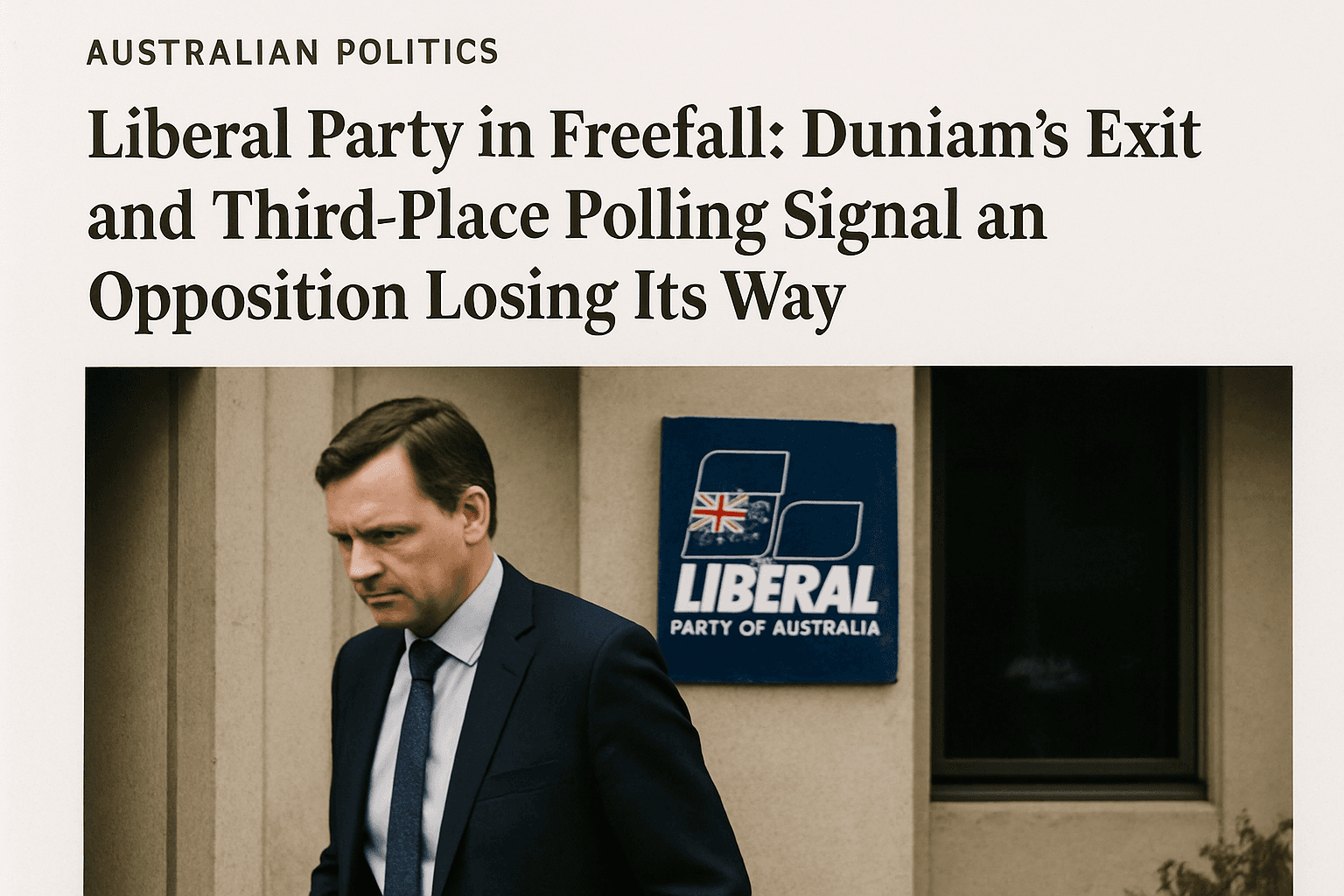
Shadow Home Affairs Minister Jonathon Duniam announced June 14 he would quit federal parliament before year's end — adding his name to a growing list of Liberal talent departures and freely admitting he was leaving "at a difficult time for the Coalition."
That word — "difficult" — deserves more pressure than it usually receives.
How bad are the numbers?
The Resolve Political Monitor, conducted June 8 to 13 and published by Nine Newspapers, shows One Nation leading the primary vote at 29% — with the ALP at 28% and the full Coalition at 20%, down three points, according to The New Daily. Roy Morgan's concurrent survey for the week ending June 7 is more granular: the Liberal Party alone at 14.5% primary support, behind the Greens at 15.5% and less than half of One Nation's 29.5%.
The Resolve poll's preferred prime minister finding is striking. For the first time, voters were offered a three-way choice. Pauline Hanson led at 33%, Anthony Albanese at 29%, and Angus Taylor — the Leader of the Opposition — at 16%, according to The New Daily's June 15 report. The leader of a party that governed Australia for nine of the past 15 years does not command the prime ministerial preference of a majority of his own voters.
Liberal Party by the numbers, June 2026
- 14.5% Liberal primary vote alone (Roy Morgan, week of June 1–7)
- 17.5% Full Coalition (Liberals + Nationals) primary in the same Roy Morgan survey
- 29.5% One Nation primary — 12 points ahead of the Liberal Party alone
- 16% Angus Taylor preferred prime minister (Resolve Monitor, June 8–13, n=1,801)
- 33% Pauline Hanson preferred prime minister — highest of any candidate
- 3 Liberal leaders in four years of opposition: Dutton, Ley, Taylor
| Election / Poll | Liberal/Coalition | One Nation | Labor |
|---|---|---|---|
| SA state election, March 2026 (avg per seat) | 18.6% | 22.1% | — |
| Roy Morgan, week of June 1–7, 2026 | 17.5% (14.5% Libs alone) | 29.5% | 26% |
| Resolve Monitor, June 8–13, 2026 | 20% | 29% | 28% |
Who is leaving, and why does that matter?
Duniam — described by political correspondent Michelle Grattan as "a good negotiator in the Senate...and a strong media performer" — is not merely another senator running out a term. He serves as the manager of opposition business in the Senate: Taylor's key operative for translating opposition strategy into legislative outcomes in the upper house.
He will leave parliament in November or December 2026, according to SBS News. He is not the only one. Senator Wendy Askew, 63, the Chief Opposition Whip in the Senate, announced her retirement earlier in June. Both of Tasmania's Liberal senators — both holding the senior Senate management roles — are simultaneously vacating the institution before an election that must be held by May 2028.
Home Affairs Minister Tony Burke offered a pointed tribute on Sky News the same day: "The Liberal Party lose one of their best and brightest when he leaves the parliament." It was a compliment and an assessment of institutional fragility delivered in the same breath.
Duniam gave the deeper explanation when describing his timing. He said the February 2026 leadership change "started to really wear on me" — adding it "was less about direction and more about my personal energy levels." That is not the language of an institution gathering momentum for a serious national campaign.
When the leadership change came along, it started to really wear on me. It was less about direction and more about my personal energy levels.
Jonathon Duniam, senator for Tasmania, Hobart press conference, June 14, 2026
What does the structural record show?
The Liberal Party has had three leaders in the four years since losing government in May 2022. Peter Dutton led until the 2025 election, when he lost his own seat. Sussan Ley then served nine months — May 2025 to February 2026 — before Taylor ousted her in a party room spill, according to Wikipedia's account of the 2026 leadership spill. Ley then resigned from parliament entirely, triggering a by-election in her NSW seat of Farrer.
On May 9, 2026, One Nation's David Farley won that by-election, defeating independent Michelle Milthorpe, according to Wikipedia's record of the 2026 Farrer by-election.
The March 2026 South Australian state election provided additional evidence of the party's structural decline. The Liberals averaged 18.6% of the primary vote per lower house seat, against One Nation's 22.1%, according to psephologist Antony Green. The combined Labor-and-Liberal primary vote fell to 56.7% — nearly 20 percentage points below its historical norm, Green noted.
Liberal leadership since 2022
- May 2022 — Peter Dutton elected leader after federal election loss
- May 2025 — Dutton loses his own seat at the federal election; Sussan Ley elected leader
- February 2026 — Ley ousted in party room spill; Angus Taylor elected leader
- February 2026 — Ley resigns from parliament, triggering Farrer by-election
- May 9, 2026 — One Nation's David Farley wins Farrer by-election
What remains unfinished?
Duniam acknowledged that Taylor had asked him to stay on "for a short period" to complete the opposition's immigration policy, which Grattan noted "is still to be fully released." Sixteen months after the 2025 election loss, the party's core point of policy differentiation from the Labor government has not been publicly released — and the person principally responsible for finalising it has announced he is on the way out.
The timing compounds the problem. The Treasury Laws Amendment (Tax Reform No. 1) Bill 2026 — Labor's capital gains tax and negative gearing overhaul — passed the House of Representatives on June 4 and heads to a Senate vote before the July 2 winter recess. Taylor needs his Senate bench at full capacity to mount any credible challenge. Instead, his manager of opposition business has given notice.
Duniam urged Liberals not to "wave the white flag" to One Nation. "Our job is to win back the votes we lost," he told reporters on Sunday. He is correct about the task. The data — three leaders, two Senate retirements in a month, a primary vote below 15%, and a leader polling third as preferred prime minister — says the party has not yet found the people to do it, and is systematically losing the ones it had.