This is an opinion and commentary piece. All factual claims are attributed to named sources.
What happened in the Wellington hearing room on June 2, 2026?
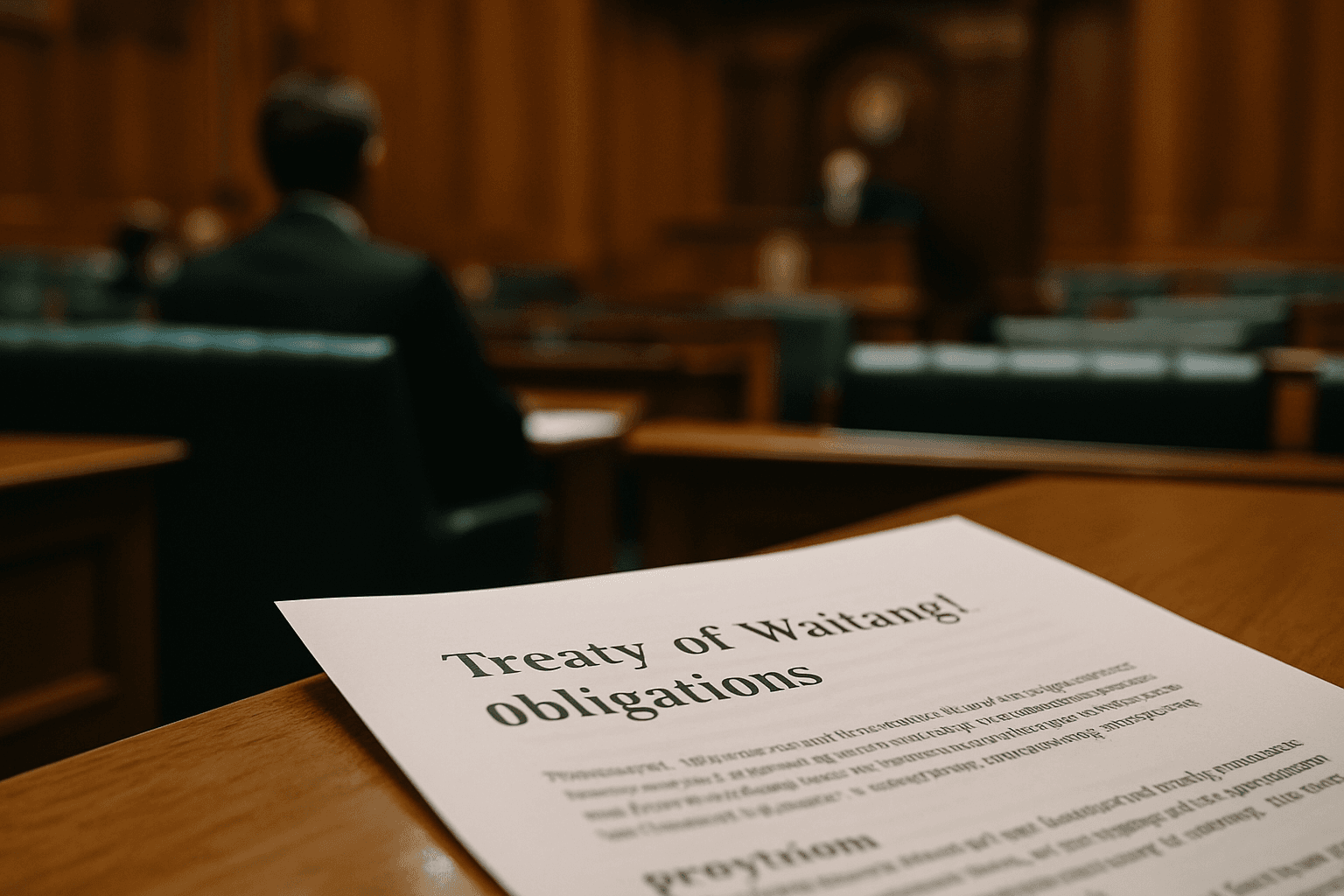
In a Wellington hearing room on the first Monday of June, Tukoroirangi Morgan — chair of Te Arataura, the executive arm of Waikato-Tainui — leaned into the microphone and told the Waitangi Tribunal something remarkable.
He said the coalition government, in two and a half years, had undone decades of progress in the Māori-Crown relationship. He said that despite Waikato-Tainui being New Zealand's largest health contractor, the iwi could not get a meeting with the current government. And he called the National-led administration, on the public record before a Crown-established tribunal, the most racist, anti-Māori government that had ever taken power, according to Te Ao Māori News.
Morgan was not speaking in the abstract. He was giving evidence in Te Tinihanga o Ngā Mātāpono o Te Tiriti — the Treaty Principles Reform Urgent Inquiry — an emergency hearing that the Waitangi Tribunal had granted after determining proposed government reforms could cause significant and irreversible prejudice to Māori. The inquiry, which concluded June 3, examined the coalition's plan to rewrite Treaty of Waitangi clauses across 19 separate New Zealand laws: weakening obligations in 10, outright repealing them in seven, and amending two others.
Legislation to implement those decisions is expected to be introduced to Parliament in early July 2026, just four months before New Zealand's Nov. 7 general election.
New Zealanders should pay close attention to what is actually being proposed, what it will do, and why the government's own case for it has collapsed under scrutiny.
What is actually being changed?
The Treaty clause review was initiated under the National-NZ First coalition agreement signed in November 2023, according to the Ministry of Justice. The deal committed to reviewing all legislation that includes references to "the principles of the Treaty of Waitangi" and replacing such references with specific wording or repealing them.
The government framed this as a tidying exercise — a matter of basic legal consistency. Justice Minister Paul Goldsmith, announcing the outcome on May 15 at the Beehive, said: "Over the last 30 or 40 years, Parliament has made all sorts of references to the principles of the Treaty of Waitangi. Sometimes it's 'honour', or 'have regard to', or 'give effect to', or 'take into account'. We need to create some consistency here, in the interests of increasing certainty and supporting compliance."
The framing sounds measured. The reality is less so.
According to the Ministry of Justice's published scope, the review targets foundational statutes covering health, children, housing, the environment, climate change, and local government.
Laws targeted by the Treaty clause review
- Pae Ora (Healthy Futures) Act 2022 — health system Treaty obligations (sections 5 and 6)
- Smokefree Environments and Regulated Products Act 1990 — Māori tobacco harm consideration (section 3AB)
- Oranga Tamariki Act 1989 — children and families (section 4(1)(f))
- Climate Change Response Act 2002 — climate law Treaty considerations (section 3A)
- Local Government Act 2002 — councils' Treaty obligations (section 4)
- Data and Statistics Act 2022 — data sovereignty (sections 3(e), 4, and 14)
- Education and Training Act 2020 — school and tertiary Treaty obligations (multiple provisions)
- Kāinga Ora-Homes and Communities Act 2019 — housing provisions
- Hauraki Gulf Marine Park Act 2000 — environmental Treaty recognition (section 6)
Under Goldsmith's announced decisions, confirmed in the Beehive press release of May 15, two references would be amended, seven would be repealed, and across 10 acts Treaty obligations would be set at no higher standard than "take into account" — a deliberate step down from the existing "give effect to" obligation in several of those laws.
The legal difference between "give effect to" and "take into account" is not a matter of drafting style. It is a substantive difference in Crown obligation. "Give effect to" requires agencies to act in accordance with Treaty principles as a primary consideration. "Take into account" merely requires decision-makers to note those principles before proceeding as they otherwise would. Constitutional law expert Dr. Carwyn Jones, appearing before the Tribunal on June 2, told the panel the proposals would shift Te Tiriti from "a foundational constitutional document into one competing consideration amongst others," according to Te Ao Māori News.
Why is the government's 'clarity' argument contradicted by its own officials?
The government's central justification — creating consistency and reducing uncertainty — is the most important claim to examine, because it does the most work in the public debate. And it is contradicted, in black and white, by the government's own officials.
The Ministry of Justice's Regulatory Impact Statement — a formal analysis officials must produce for significant government proposals — was released alongside the May hearings and reported on by The Spinoff and the NZ Herald. Its assessment of Goldsmith's approach, described internally as "Option five," was unambiguous.
"Option five has no apparent benefits and carries significant risks to the Māori-Crown relationship."
Ministry of Justice Regulatory Impact Statement, as reported by The Spinoff, June 4, 2026
The NZ Herald reported the statement went further: officials found "there is limited evidence available to support the assumption existing provisions are causing uncertainty and the proposals would result in greater certainty" — and, most damaging of all, that "in all instances, repeal is likely to increase, rather than decrease, uncertainty."
This is not an interpretation of official advice. It is a direct excerpt from a government document. The ministry's own analysis concluded that Goldsmith's preferred approach — the one Cabinet adopted on Feb. 23, 2026, according to the Ministry of Justice — would do the opposite of what it claims. Rather than reducing litigation risk and legal ambiguity, officials warned, repeal would generate new legal questions, because the Treaty's relevance to each statute would no longer be codified.
The Ministerial Advisory Group that oversaw the review also reportedly did not recommend Goldsmith's approach. As The Spinoff's June 4 account noted, citing the Regulatory Impact Statement, Goldsmith "developed and is implementing the 'taking into account' approach" over the objections of that process.
Prime Minister Christopher Luxon, when pressed by Te Ao Māori News reporters after the Tribunal's May stage-one report, did not contest this account. He reiterated the consistency rationale — "we wanna make sure we uphold our obligations as a Crown, that we're clear about what our roles are to each other" — but did not address the officials' finding that the specific option chosen would fail on those very terms.
What went wrong with the consultation process?
Goldsmith's May 15 announcement included the assurance that "we are now consulting with Iwi, and the legislation will go through a full select committee process where all New Zealanders can have their say."
The Waitangi Tribunal, which reviewed the same record, reached a different conclusion.
In its stage-one report on the Education and Training Act, released May 15, the Tribunal found the Crown failed to meaningfully engage with Māori by consulting only with the National Iwi Chairs Forum — and doing so only after substantive decisions had already been made. Presiding officer Judge Rachel Mullins wrote that the Justice Minister's view that the select committee would otherwise provide sufficient input was "manifestly inadequate and an insult to Māori," as reported by RNZ.
At the June 2-3 hearing, Professor Margaret Mutu — a co-chair of the National Iwi Chairs Forum — told the Tribunal that the forum had been given fewer than 20 days to consult with more than 85 Māori authorities and compile their feedback, according to The Spinoff. Mutu also disclosed that while her co-chairs had been told the prime minister's office was arranging a meeting with Luxon to discuss the changes, as of the June hearing no such meeting had been scheduled. "I have neither been asked what times I'm available nor been advised of a proposed meeting time," she said, as reported by Te Ao Māori News.
A further element received less public attention. Documents reviewed by Te Ao Māori News in May showed that Goldsmith had directed officials to remove regional hui — face-to-face community meetings across the country — from the engagement process, replacing them with the smaller ministerial advisory group. Regional hui are the standard mechanism by which iwi, hapū and whānau who are not part of national bodies can engage with Crown policy. Canceling them did not merely limit consultation; it structurally excluded the vast majority of Māori communities from the process.
The Tribunal's stage-one report found the Crown had "acted contrary to officials' advice and demonstrated a reckless disregard for the (likely and advised) harm to the Māori-Crown relationship," according to RNZ's May 15 report.
The government's response was to reject those findings outright. Luxon told reporters the government would "continue pressing ahead." Education Minister Erica Stanford said only that she "respected the Waitangi Tribunal process" and would await further reports.
What do these clauses actually do in practice?
In public debate, Treaty clauses are often discussed as if they were symbolic boilerplate. The June hearing made clear they are not.
Shane Bradbrook, appearing before the Tribunal on behalf of Te Rōpū Tupeka Kore — a collective of tobacco-cessation experts — described what the Treaty clause in the Smokefree Environments and Regulated Products Act does in practice. Section 3AB requires the minister to consider the risks and benefits to Māori before preparing regulations on smoked tobacco products. That provision creates a "pathway for a considered, mature conversation" about tobacco regulation and enables equity-focused, by-Māori-for-Māori health programs, Bradbrook said.
"You rip that out, and it stops a pathway for that considered, mature conversation, in this case, about a product that addicts and kills," he told the Tribunal, as reported by 1News. "This approach undermines the legal weight of the Treaty."
Hone Harawira, also speaking for Te Rōpū Tupeka Kore, warned that removing the Treaty clause would cause "significant prejudice to Māori," noting Māori smoking rates remain disproportionately high, according to The Spinoff.
Dr. Chris Tooley, chief executive of Māori health provider Te Puna Ora o Mataatua, told the Tribunal that weakening the Treaty provisions in the Pae Ora Act from "give effect" to "take into account" would cause health providers serving communities with "grave health inequalities" to suffer "significant and irreversible prejudice." He described equity funding formulas already removed, Māori patients losing GP access, and whānau staying home rather than presenting to hospital — and said the Treaty clauses were among the last statutory safeguards requiring the health system to consider those outcomes at all.
Waikato-Tainui chief executive Donna Flavell, speaking June 3, told the Tribunal that changes affecting education, health, Oranga Tamariki, and environmental management had proceeded without meaningful engagement with the iwi. "If the proposals were to proceed," she said, "the result will be further erosion of Māori participation, diminished accountability, and increased inequity across systems that directly impact our people and our babies, our mokopuna," according to Te Ao Māori News.
Kirikowhai Mikaere, lead technician for Te Kahui Raraunga, also raised the implications of the Data and Statistics Act changes for Māori data sovereignty — the ability of Māori to control information about themselves. That, too, would be reduced to a consideration rather than an obligation.
These are not theoretical concerns. They are operational realities described by practitioners in health, tobacco cessation, child welfare, and environmental management — the people who work within the legal framework these clauses create.
How does the Treaty settlement record contradict the government's position?
One of the most striking aspects of the June hearing, reported by both The Spinoff and Te Ao Māori News, was the evidence of Charles Rahiri, chair of Tauranga iwi Ngāti Ranginui.
Ngāti Ranginui settled its Treaty claim with the Crown in 2025. Just a year before the June hearing, the Crown had apologized to the iwi for historic breaches — acknowledging the harm done and committing to a new relationship "based on trust, cooperation and respect for Te Tiriti."
Rahiri's submission was, at its core, about what that apology now means.
"The Crown cannot apologise in 2025 and repeat the same behaviours it apologised for in 2026," he told the Tribunal, as reported by Te Ao Māori News. "It cannot promise partnership, then legislate away the mechanisms that uphold it. That is not how a Treaty partner behaves."
This is not a rhetorical flourish. Treaty settlements are premised on the Crown acknowledging wrongdoing and committing to a changed relationship. The Treaty clauses the government now proposes to weaken or repeal are part of the legislative architecture that gives that commitment practical effect. Removing them from statutes like the Pae Ora Act — which governs how the health system must relate to Māori — does not merely reduce a legal obligation. It removes the mechanism by which a recently-apologized-for pattern of Crown conduct could be detected and challenged.
Natalie Coates, representing lead claimant Ngāti Hine, made the related point that the government was forcing settled iwi to use financial redress money — compensation received from Treaty settlements for historical land confiscation — to fund litigation against the government's current policies. The settlement was supposed to resolve the past, not create new grounds for future legal battles. Yet as the government's own Regulatory Impact Statement warned, repealing Treaty clauses will not reduce litigation. It will generate new cases.
Is this an isolated decision, or part of a pattern?
The Treaty clause review should be understood in context. It is the fourth or fifth act in a systematic program.
The coalition's Treaty rollback since 2023
- Nov. 2023 — National-NZ First coalition agreement commits to Treaty clause review and Treaty Principles Bill
- Early 2024 — Te Aka Whai Ora (Māori Health Authority) abolished; co-governance arrangements in health dismantled
- Mid 2024 — Section 7AA of the Oranga Tamariki Act (requiring reduction of Māori over-representation in care) repealed
- Nov. 2024 — Treaty Principles Bill introduced; first reading passes 68-54
- April 2025 — Treaty Principles Bill rejected 112-11 at second reading after more than 300,000 public submissions
- July 2024–Oct. 2025 — Māori wards referendum legislation enacted; 42 councils hold binding referendums; 24 vote to remove wards, 18 to keep — despite nearly 75,000 more votes nationally for keeping them
- Feb. 23, 2026 — Cabinet decides to cap Treaty standards in 19 laws at "take into account"
- May 2026 — Goldsmith announces full scope of 19 laws; Tribunal stage-one report finds Crown in breach over education changes
- June 2-3, 2026 — Broader urgent Tribunal inquiry held; report expected before July bill introduction
The Spinoff's account of the June hearing noted that claimants repeatedly catalogued this accumulation, citing "the disestablishment of Te Aka Whai Ora, prioritisation of English over te reo Māori, enabling the removal of Māori wards and repealing section 7AA of the Oranga Tamariki Act" as evidence of a pattern.
Morgan framed it directly: "Since this coalition government was elected more than two years ago, we have watched the unrelenting assault on our rights and interests under Te Tiriti o Waitangi," according to Te Ao Māori News.
The government contests the characterization. Goldsmith has consistently described the review as clarification, not diminishment. But the evidence from his own ministry — that the chosen approach "has no apparent benefits" and will likely increase rather than decrease legal uncertainty — makes the clarification argument very difficult to sustain.
It is also worth noting what the government did not review. Treaty settlement legislation was explicitly excluded from scope. The State-Owned Enterprises Act was excluded. The Resource Management Act was excluded — because the government intends to repeal and replace it through separate legislation. What remains in scope is precisely the area where Treaty obligations protect Māori communities in their ongoing interactions with the state: health, education, child welfare, environmental management, housing, and data. That is not coincidence. It is the architecture of the rollback.
What has the Waitangi Tribunal found — and what happens next?
The Tribunal has now issued two related findings on the Treaty clause review.
In its Ngā Mātāpono Part III report, published in October 2025, the Tribunal found that if the Crown proceeded with the review "as currently planned," it would breach Treaty principles — but said it was "not too late to refocus the review" through genuine co-design with Māori, according to the Waitangi Tribunal's own release.
The Crown did not refocus the review. Cabinet made its final decisions on Feb. 23, 2026.
In May 2026, the Tribunal's stage-one report on the Education and Training Act found the Crown in breach of the Treaty principles of partnership, active protection, and good government. Judge Mullins wrote that the changes were "as bad as the Treaty Principles Bill in its attempt to erase the Crown's duty to comply with the agreement made between Māori and the Crown in 1840. It may even be worse, because the Treaty Principles Bill in theory was never going to be enacted," as reported by RNZ.
The Treaty Principles Bill, for context, was rejected by Parliament 112 votes to 11 at its second reading in April 2025, according to Wikipedia's legislative record. Only ACT's 11 members voted for it. Every other party in Parliament voted against. The Tribunal's comparison is therefore pointed: where the Principles Bill failed publicly and spectacularly, the clause review proceeds quietly through Cabinet and a drafting process.
Dr. Carwyn Jones described the proposed changes to 1News as "the most wide-ranging legislative breach of Te Tiriti in modern history" and told the Tribunal that if the Crown proceeded, "it will be one of the darkest days for Te Tiriti in all of its 186 years."
The Tribunal's recommendations are not legally binding. The government has rejected all findings in this series. Claimants and submitters told the June hearing they did not expect the Tribunal's forthcoming report to change the outcome. The panel — presided over by Chief Judge Dr. Caren Fox, with members Derek Fox, Dr. Paul Hamer, and Kevin Prime — heard two days of testimony and was awaiting closing submissions, with its report expected before the bill's introduction in July 2026, according to The Spinoff.
What is the government's strongest case?
Fairness requires presenting the coalition's position in its strongest form.
Goldsmith and Luxon have a genuine point that the existing landscape of Treaty references is inconsistent. The phrases "honour," "give effect to," "have regard to," and "take into account" do appear across the statute book, imposing different obligations on different agencies.
It is also true — as the Regulatory Impact Statement noted — that the existing case law on what Treaty clauses require is relatively settled. Courts, through decades of decisions, have developed a coherent body of interpretation. But settled law is not the same as settled policy outcomes, and if the clauses are working, the case for removing them is weaker, not stronger.
The government has also continued to progress Treaty settlements and has committed to signing new ones. That work is genuine and should be acknowledged. The clause review does not touch settlement legislation.
And the coalition's broader political argument — that Labour-era expansion of co-governance arrangements generated a democratic backlash and a mandate to roll some back — is not without foundation. The 2023 election produced a government on a platform that explicitly included this review. The Māori wards referendums produced majorities for removal in 24 of 42 councils, even if the national vote count, with nearly 75,000 more keep votes than remove votes nationally, according to Wikipedia's referendum results, narrowly favored retention.
But mandate is not the same as correctness. The Treaty Principles Bill also had a coalition mandate — and Parliament voted it down 112-11. The consistency of democratic challenge to this family of policies suggests they test the limits of what a governing majority can legitimately do to the constitutional relationship.
What does public opposition look like at this scale?
While the formal legal process proceeds at the Tribunal, a different measure of public sentiment is on record.
Toitū Te Tiriti — the public interest coalition that brought evidence at the June hearing — disclosed that more than 72,000 people had formally signed on to their claim, including 54,319 who identify as Māori, according to Te Ao Māori News. That is a substantial number of New Zealanders who took the step of formally registering their opposition.
For context: the Treaty Principles Bill drew more than 300,000 public submissions to the Justice Committee — the vast majority opposed — before being rejected 112-11.
The Treaty clause review did not proceed through that public submission process before Cabinet made its decisions. It went through a ministerial review group appointed by Goldsmith, and a Cabinet paper process. Public participation is now slated for the select committee stage, after the bill is introduced. By that point, drafting decisions will have been made, the coalition agreement fulfilled, and political momentum to proceed will be formidable.
This is precisely the sequencing the Tribunal's stage-one report criticized: substantive decisions made first, consultation offered afterward, when the ability to shape outcomes is greatly reduced.
Why this must stop
This piece argues that the Treaty clause review, as currently designed, should not proceed. The case rests on four failures — each individually serious, and together disqualifying.
First, the process was wrong. Regional hui were canceled. Consultation was offered to one national body with fewer than 20 days and no confirmed meeting with the prime minister. The Waitangi Tribunal, twice, found the Crown in breach of its Treaty obligation of partnership and good faith. These are not technicalities. They are the minimum conditions under which a Crown proposal to alter Treaty obligations can be legitimate.
Second, the stated rationale is contradicted by the government's own evidence. The Ministry of Justice's Regulatory Impact Statement found the approach Goldsmith chose has "no apparent benefits," will likely increase legal uncertainty, and poses significant risks to the Māori-Crown relationship. A government that proceeds on those terms is not reducing uncertainty. It is choosing to disregard its own analysis because the policy serves coalition politics.
Third, the practical harm is documented and serious. From tobacco mortality to Māori child welfare, from health system equity to data sovereignty, the practitioners who work within these statutory frameworks described at length what these clauses protect. Removing a legal obligation to consider Māori interests does not make those interests disappear. It makes ignoring them easier — and legally safer.
Fourth, the constitutional contradiction is real. This government has signed Treaty settlements, apologized for historical breaches, and promised a different relationship — and then proposed to legislate away the mechanisms that give that promise practical effect. An apology that comes with the simultaneous removal of accountability mechanisms is not an apology. It is a gesture.
The Tribunal's reports are not binding. But they represent the considered legal judgment of Crown-appointed experts examining Crown conduct against New Zealand's founding document. When that body finds, across multiple inquiries, that the same government has breached Treaty principles in health, education, local government, and now across a further 19 laws, the accumulation is not incidental.
"Governments come and go," Tukoroirangi Morgan told the Tribunal at the close of his June 3 submission, as reported by Te Ao Māori News. "Iwi and hapū are forever."
That is true. But the legislative framework matters now. It determines who gets to see a doctor, who gets help quitting smoking, whose children are protected, whose environment is considered, whose data is sovereign. Weakening those provisions — against official advice, without adequate consultation, through a process designed to avoid the public scrutiny that killed the Treaty Principles Bill — is not clarification. It is diminishment. And it should stop.
This commentary draws on publicly reported proceedings of the Waitangi Tribunal's Te Tinihanga o Ngā Mātāpono o Te Tiriti urgent inquiry (June 2-3, 2026), the Tribunal's stage-one education report (May 14-15, 2026), the Ministry of Justice's Treaty clause review page, and the government's Beehive press release of May 15, 2026. All quotations are attributed to named sources in cited reporting.