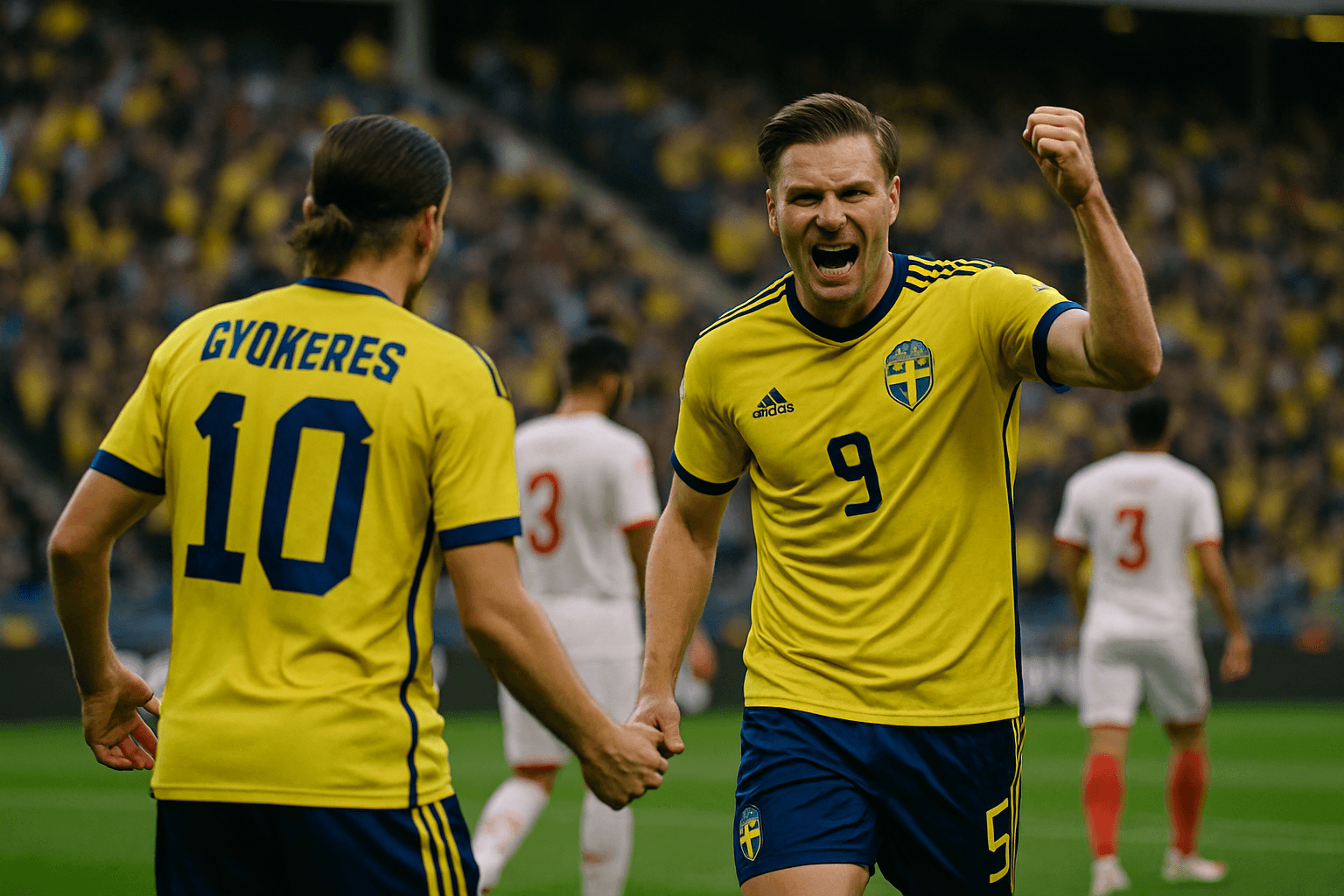
Sweden walked back into the World Cup after a four-year absence and immediately answered the question that has unnerved managers and pundits for months: can Alexander Isak and Viktor Gyökeres actually coexist at international level?
On the evidence of their 5-1 demolition of Tunisia in Guadalupe, Mexico, on June 14-15, the answer is an emphatic yes — and the implications for Group F, and for the tournament as a whole, are significant.
What made Sweden's performance historically unusual?
The scoreline alone flatters Tunisia, a side that had not conceded a single goal in World Cup qualifying — becoming the first nation to achieve that feat, a record later matched by Côte d'Ivoire and England, according to Al Jazeera. Five goals in one game obliterated that record, but the manner matters more than the margin.
According to Opta, Sweden's expected goals (xG) total was just 1.36, against Tunisia's 0.28. Sweden scored five goals from a chance profile that modeled roughly one. That gap reflects clinical finishing, not defensive incompetence alone. Sweden finished with 13 total shots to Tunisia's six, and the shot locations told their own story.
More striking still: three of those five goals came from outside the penalty area. According to Opta Analyst, that makes Sweden only the second team to score three goals from outside the box in a single World Cup match since 1966, alongside Germany against Chile in 1962. This is not the signature of route-one pragmatism — it is evidence of a side with technically diverse attacking outlets capable of punishing any defensive structure.
Sweden 5-1 Tunisia — By the Numbers
- 5-1 — Final score; Tunisia had conceded zero goals across the entire qualifying campaign
- 1.36 to 0.28 — Sweden's expected goals vs. Tunisia's (Opta)
- 13 to 6 — Sweden's total shots vs. Tunisia's
- 3 — Sweden's goals from outside the box, only the second team to do so in one World Cup match since 1966
- 18 seconds — Time Mattias Svanberg took to score after coming on as a substitute
- 4 years — Sweden's absence from the World Cup, having failed to qualify in 2022
Five goals and solid, we could've scored more. All credit to the players; they were fantastic. There is room to improve.
Graham Potter, Sweden head coach
How did Potter solve the co-striker problem?
The question of how to deploy both Isak of Liverpool and Gyökeres of Arsenal in the same starting XI has shadowed Sweden's preparation. Both are elite central strikers who prefer operating through the middle — the kind of selection headache that has undone international managers for generations.
Potter's answer was a 3-1-4-2 shape that asked each forward to accept a half-role: Isak drifting wide and deep enough to link play, Gyökeres staying central as the primary presser and finisher. The arrangement produced assists in both directions — Isak set up Gyökeres, and Gyökeres returned the favour — making them, according to sources close to the team, only the second Swedish strike partnership in World Cup history to assist each other's goals.
The UEFA squad preview had already flagged the pair as "arguably one of the most exciting striker pairings in the tournament." Against Tunisia, that billing looked conservative. Isak's Sofascore rating of 8.8 reflected a performance that went beyond the goal column, combining finishing with the kind of creative link play that justifies his deeper starting position.
What does Yasin Ayari's subdued celebration reveal about this squad?
One of the match's defining images was Ayari's muted response to his opening goal in the seventh minute. The 22-year-old midfielder, who holds dual citizenship according to Transfermarkt, has a father from Tunisia and a mother of Moroccan descent. The Tunisian Football Federation approached him about switching international allegiance in 2021.
His father, Azzouz Ayari, told Swedish newspaper Aftonbladet that he encouraged his son to remain with Sweden. "I wanted him to play for Sweden," Azzouz said. "He should feel like he is giving back to the country that took care of him."
Ayari's decision, and his visible conflict at the moment of scoring, encapsulates something broader about this Sweden squad: it is multicultural, emotionally complex, and in several cases built from stories of migration and dual identity. That is not incidental colour — it is part of what makes this group cohesive and motivated in ways that pure footballing analysis cannot fully capture.
What do Sweden's remaining fixtures mean for Group F?
Sweden now sit top of Group F after Matchday 1. Their remaining schedule is demanding: Netherlands on June 20 in Houston and Japan on June 25 in Dallas, according to Mappr. Both the Netherlands and Japan collected one point apiece after drawing 2-2 in their opener, meaning the June 20 clash between Sweden and the Netherlands already carries the weight of a potential group-stage decider.
Sweden's Group F schedule
- June 14-15 — Sweden 5-1 Tunisia (Guadalupe, Mexico)
- June 20 — Sweden vs. Netherlands, Houston Stadium (1 p.m. ET)
- June 25 — Sweden vs. Japan, Dallas Stadium (7 p.m. ET)
The broader tournament picture is this: a Sweden side that failed to qualify four years ago has arrived in 2026 with a functional tactical identity, two of Europe's most dangerous forwards operating in tandem, and a psychological edge built from that absence. One match proves nothing. But as opening statements go, this one was hard to ignore.