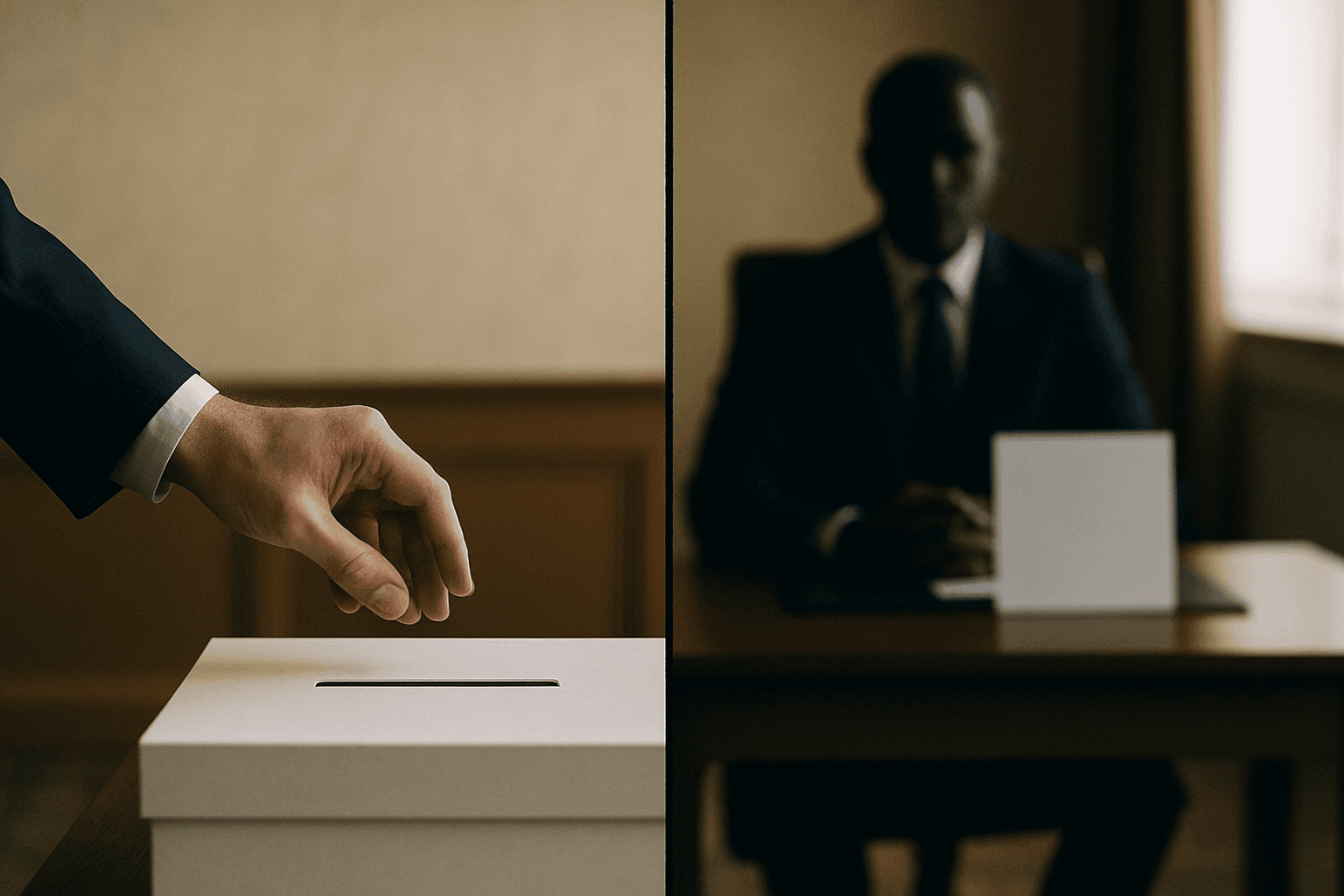
Kaikohe, April 15, 2026: Democracy in Action
The chambers at Kaikohe drew the largest media contingent the Far North District Council had seen in years. Protesters lined the pavement outside with handmade banners. Inside, elected councillors prepared to vote on a question that had ignited a nationwide social media firestorm: whether to expand the membership of Te Kuaka Māori Strategic Relationships Committee — a body that, despite weeks of viral outrage, could only make recommendations, not final decisions[1]Banning voting rights an attempt to 'silence the Māori voices in the room' - iwi leader“All members - elected and unelected - can vote, but the committee can only make recommendations, not final decisions.”, with all binding votes reserved to the full council.
Nathaniel Keripeti-Edwards, a committee appointee from Ngātiwai, addressed the meeting before the vote. "You do not make decisions about people without them," he said, reported by RNZ[12]Far North councillors vote to expand controversial Māori liaison committee“This committee isn't illegal or unlawful. It's a committee that makes recommendations, it doesn't make decisions, and it's not a co-governance committee.”. "You do not speak for others when they can speak for themselves."
The vote came in nine to one in favour of expanding the committee[13]ACT councillor the only vote against more Māori voices for Far North council committee“At today's meeting, councillors voted (nine to one with one abstaining) to confirm representatives from specific hapū to sit on the council's Te Kuaka committee.”, with only ACT councillor Davina Smolders dissenting. Every other elected member — the very representatives ratepayers had chosen — decided that including Northland iwi voices in the advisory process was the right thing to do.
Less than seven weeks later, the government stepped over them.
What the Government Did — and What It Called It
On June 2, 2026, Local Government Minister Simon Watts announced an amendment to the Local Government (System Improvements) Bill[3]Government to remove voting rights from iwi representatives on council“The bill has already reported back from select committee meaning the public will not be given the opportunity to submit on the changes announced today.” — a bill that had already passed through the select committee stage, meaning the public would have no opportunity to submit on the change. Under the amendment, only elected councillors would be able to vote on council committees. Unelected appointees — iwi representatives, independent experts, youth council members — could still attend and offer advice, but their votes would be stripped and would no longer count toward a quorum.
Watts framed this as a straightforward matter of democratic principle. "Councillors are directly accountable to voters for their decisions,"[6]Government moves to ban unelected members from voting on council committees“That is hardly a massive dilution of democracy, those two extra voices — Hastings Mayor Wendy Schollum” he said. "That's not democratic, so we're fixing it."
ACT's local government spokesperson Cameron Luxton called it "a massive win for ratepayers and local democracy"[2]Law change will stop councils appointing iwi representatives as full voting members“Councillors are directly accountable to voters for their decisions — Watts on June 2 announcement”, adding that his party had been pressing the minister to act. The Spinoff[10]Increasing anger over government's approach to Māori rights“It has been a big issue for Act, New Zealand First and Hobson's Pledge, who have cast it as co-governance in disguise — NZ Herald's Audrey Young”'s Henry Oliver reported the following day that, according to NZ Herald[13]ACT councillor the only vote against more Māori voices for Far North council committee“At today's meeting, councillors voted (nine to one with one abstaining) to confirm representatives from specific hapū to sit on the council's Te Kuaka committee.”'s Audrey Young, the move was driven in part by competition within the centre-right: "It has been a big issue for Act, New Zealand First and Hobson's Pledge, who have cast it as co-governance in disguise. It was promising to become a campaign flashpoint for them in the run-up to November's election — against National as much as opposition parties."[10]Increasing anger over government's approach to Māori rights“It has been a big issue for Act, New Zealand First and Hobson's Pledge, who have cast it as co-governance in disguise — NZ Herald's Audrey Young”
This is the story the government told. The story the evidence tells is considerably more complicated.
The Advisory-Only Reality the Government Won't Name
To understand why the "democratic accountability" argument fails, it is necessary to understand what the Te Kuaka committee actually does — and what it does not do.
The committee can vote, but it can only make recommendations. Final decisions remain with the full elected council[1]Banning voting rights an attempt to 'silence the Māori voices in the room' - iwi leader“All members - elected and unelected - can vote, but the committee can only make recommendations, not final decisions.”. As former Kaipara Māori ward councillor Pera Paniora told the crowd outside the Kaikohe chambers in April: "This committee isn't illegal or unlawful. It's a committee that makes recommendations, it doesn't make decisions, and it's not a co-governance committee."[12]Far North councillors vote to expand controversial Māori liaison committee“This committee isn't illegal or unlawful. It's a committee that makes recommendations, it doesn't make decisions, and it's not a co-governance committee.”
The government's framing deliberately collapsed this distinction. In singling out Far North, Tauranga, and Hastings as places where "individuals... have been given full voting rights on committees without being elected by the community," Watts omitted the critical qualifier: that those votes could only ever generate recommendations, not bind the council. Elected councillors retained the final word on every substantive matter.
This is not a trivial distinction. It is the difference between saying iwi had decision-making power — which they did not — and saying they had a formal voice in advisory proceedings, which is precisely what the Local Government Act requires. Section 81 of the Local Government Act 2002 obliges councils to take steps to enable Māori to participate in decision-making. The Act explicitly states councils can appoint any number of unelected members to their committees[12]Far North councillors vote to expand controversial Māori liaison committee“This committee isn't illegal or unlawful. It's a committee that makes recommendations, it doesn't make decisions, and it's not a co-governance committee.”, recognising that effective governance often requires input beyond the elected chamber.
The government's amendment does not change the advisory status of these committees. It does something narrower and more pointed: it removes the formal voting mechanism through which Māori advisory voices are weighed inside council deliberations, making those voices structurally lighter than those of elected members — not just in the binding chamber, but in the advisory room that feeds it.
The Far North Te Kuaka committee, in numbers
- 10 iwi and hapū representatives on Te Kuaka advisory committee
- 6 elected councillors on the same committee
- 9-to-1 vote by elected Far North councillors in April 2026 to expand the committee
- 0 binding powers held by the committee — all final votes rest with the full council
- 0 public submissions will be received on the government's proposed change (added after select committee)
The Contradiction No One in Government Wants to Answer
If the principle underlying the Watts announcement is that only elected people should hold voting power in council governance processes, that principle is immediately tested against a rather large exception the government has itself created: Local Water Done Well.
Under the government's water reform programme, councils around the country are establishing council-controlled organisations (CCOs) to take over drinking water and wastewater services. These CCOs will be substantial entities: at Hamilton City Council[9]Local water done well — Hamilton City Council“In 2023-24 water accounted for around 30% of the Council's annual operating expenditure, 54% of the proposed capital expenditure over the life of the 2024-34 Long-Term Plan”, water accounted for around 30% of the council's annual operating expenditure in 2023-24, and 54% of proposed capital expenditure over its 10-year plan[9]Local water done well — Hamilton City Council“In 2023-24 water accounted for around 30% of the Council's annual operating expenditure, 54% of the proposed capital expenditure over the life of the 2024-34 Long-Term Plan”. At Tauranga, Mayor Mahé Drysdale put the figure plainly: "You've got 30 percent of council business going to be run by a CCO, which is made up of unelected members."[1]Banning voting rights an attempt to 'silence the Māori voices in the room' - iwi leader“All members - elected and unelected - can vote, but the committee can only make recommendations, not final decisions.”
Those unelected members are not there by accident. They are there by legal requirement. The Local Government (Water Services) Bill provides that a water services CCO must have an independent, competency-based board, which cannot include people who are elected members or employees of a council that is a shareholder in the organisation[7]What is a water services Council-Controlled Organisation (CCO)?“must have an independent, competency-based board, which cannot include people who are elected members or employees of a council that is a shareholder in the organisation”.
The Waikato Waters CCO, which became operational in July 2025, states this precisely: "The Board is made up of directors who are experienced in governance/leadership in commercial, strategic and business activities and they cannot be current elected members or staff of councils."[8]Questions and answers — Waikato Water Done Well“The Board is made up of directors who are experienced in governance/leadership in commercial, strategic and business activities and they cannot be current elected members or staff of councils.”
So the government's position, stripped of its democratic framing, is this: unelected people must not vote on advisory council committees that deal with land, water, environment, and Māori partnership — even when their votes can only recommend — but unelected people must run CCOs that make real, binding financial and infrastructure decisions affecting 30% of council business, and elected councillors are legally barred from those boards.
You've got 30 percent of council business going to be run by a CCO, which is made up of unelected members. So I'm a little bit confused as to what they're trying to solve.
Mahé Drysdale, Mayor of Tauranga, June 3, 2026
Drysdale identified the contradiction without hesitation. The government has not resolved it — because there is no principled resolution available. What is consistent across both positions is not a principle about elected accountability. It is a pattern: Māori advisory participation is targeted; corporate governance boards are not.
Democracy Used to Bypass Democracy
The procedural manner in which this change is being made compounds the substantive problem.
Normally, when a government wants to make significant changes to local government law, it introduces legislation, sends it to a select committee, and invites the public to make submissions. This is the standard democratic process, and it is what happened with the rest of the Local Government (System Improvements) Bill.
But the amendment removing iwi voting rights was added to the bill after it had already reported back from select committee, meaning the public will not be given the opportunity to submit on the changes[3]Government to remove voting rights from iwi representatives on council“The bill has already reported back from select committee meaning the public will not be given the opportunity to submit on the changes announced today.”.
Te Pāti Māori co-leader Rawiri Waititi did not miss the irony. "They have the cheek to call iwi representation 'undemocratic' while they are pushing through these changes without a select committee process,"[10]Increasing anger over government's approach to Māori rights“It has been a big issue for Act, New Zealand First and Hobson's Pledge, who have cast it as co-governance in disguise — NZ Herald's Audrey Young” he said.
The government's use of a post-select committee amendment to enact a nationally significant change to local Māori participation in governance — without any public consultation mechanism — is a procedural democratic shortcut to achieve what it frames as a democratic improvement. The gap between the stated justification and the method chosen to implement it is significant enough to deserve naming: the government used an anti-democratic procedure to champion democratic accountability.
Dunedin Councillor Christine Garey was "outraged" by the announcement, describing it as something the government had "sneaked through"[5]Limiting voting rights 'slap in the face' for iwi“Dunedin Mayor Sophie Barker said announcement went against 'three principles of the spirit of the Treaty of Waitangi... partnership, protection and participation'”. She had good reason. The DCC's Te Pae Māori mana-to-mana committee, its iwi representation on Finance and Performance and Policy and Planning committees, and its independent Audit, Risk and Assurance Committee chair were all caught in the blast radius of a change designed without councils' input and announced without warning.
How the Far North conflict became national policy
- Late 2024 — ACT councillor Davina Smolders raises concerns about Far North's Te Kuaka committee in podcast interview, claims it is "co-governance on steroids" and "illegal"
- April 15, 2026 — Far North District Council votes 9-to-1 to expand Te Kuaka committee; ACT councillor Smolders is only dissenter
- June 2, 2026 — Minister Watts announces amendment to Local Government (System Improvements) Bill, removing voting rights from unelected committee members nationwide; no public submissions to be taken
- June 3, 2026 — Mayors in Tauranga, Dunedin, Wellington, and Hastings push back; Northland iwi leaders call it an attempt to silence Māori voices
- June 9, 2026 — Te Kāhui Whakarehunga (Te Upoko o Te Ika iwi collective) condemns the move; grows opposition from multiple iwi collectives
- June 14, 2026 — Rotorua Lakes Council seeks clarification on how the law will affect its own iwi partnership bodies
- June 16, 2026 — Justice Minister Paul Goldsmith tells Parliament's Māori Affairs Select Committee that Crown-Māori relations are "in good shape"
A Chorus of Mayors Across the Country
The reaction from local government leaders — the very elected people whose authority the government claimed to be protecting — was strikingly unified in its criticism.
Dunedin Mayor Sophie Barker said the announcement went "against three principles of the spirit of the Treaty of Waitangi... partnership, protection and participation"[5]Limiting voting rights 'slap in the face' for iwi“Dunedin Mayor Sophie Barker said announcement went against 'three principles of the spirit of the Treaty of Waitangi... partnership, protection and participation'” and described herself as "gobsmacked."
Wellington Mayor Andrew Little — the former Labour leader — called it "unnecessary and a provocation" and said it "just seems to me another unnecessary provocation by this government towards Māori."[1]Banning voting rights an attempt to 'silence the Māori voices in the room' - iwi leader“All members - elected and unelected - can vote, but the committee can only make recommendations, not final decisions.” He said he would prevail on Wellington's iwi partners to stay involved regardless.
Hastings Mayor Wendy Schollum questioned both the substance and the method. Her council's unelected members sit on bodies that only make recommendations back to the elected council, which still casts all binding votes. "That is hardly a massive dilution of democracy, those two extra voices,"[6]Government moves to ban unelected members from voting on council committees“That is hardly a massive dilution of democracy, those two extra voices — Hastings Mayor Wendy Schollum” she said. She also asked a question the government has not answered: "I really want to understand whether this is really the issue that is most urgent and needs nationwide legislative response."
Te Rūnanga o Ōtākou upoko Edward Ellison described the announcement as a "slap in the face,"[5]Limiting voting rights 'slap in the face' for iwi“Dunedin Mayor Sophie Barker said announcement went against 'three principles of the spirit of the Treaty of Waitangi... partnership, protection and participation'” saying that iwi representation on council committees had greatly improved dialogue and cultural knowledge on both sides.
In Rotorua — a city with deep, legally-established Māori governance relationships across multiple statutory bodies — Mayor Tania Tapsell said "we don't know yet" how the change would apply to bodies such as the Te Arawa Vision 2050 Committee[14]Unelected voting rights change puts Rotorua iwi representation in the spotlight“Tapsell said statutory co-governance groups established through Treaty of Waitangi settlement legislation, such as the Rotorua Te Arawa Lakes Strategy Group, were likely to be exempt from the Government's proposal.”, because the government announced a nationwide law change without consulting the councils it would affect.
What the Government's Own Exemptions Reveal
There is a detail buried in the announcement that exposes the incoherence of the government's stated rationale more clearly than any external critique: the exemptions.
Statutory bodies established through Treaty of Waitangi settlements, and committees created under legislation outside the Local Government Act, will keep their voting rights[6]Government moves to ban unelected members from voting on council committees“That is hardly a massive dilution of democracy, those two extra voices — Hastings Mayor Wendy Schollum”. As Rotorua's Mayor Tapsell confirmed, bodies like the Rotorua Te Arawa Lakes Strategy Group, established through Treaty settlement legislation, are likely to be exempt[14]Unelected voting rights change puts Rotorua iwi representation in the spotlight“Tapsell said statutory co-governance groups established through Treaty of Waitangi settlement legislation, such as the Rotorua Te Arawa Lakes Strategy Group, were likely to be exempt from the Government's proposal.”.
The government has thus drawn a line that turns entirely on legal form, not on democratic logic: unelected iwi representatives who participate in governance structures created through Treaty settlements can vote; unelected iwi representatives who participate in structures created by elected councils exercising their existing legal powers cannot.
But the democratic objection — if that is genuinely what drives the change — applies equally to both. If an unelected person holding a vote alongside six elected councillors on a merely advisory committee is "not democratic," then it ought to be equally problematic when an unelected person holds the same vote under a Treaty settlement framework. The principle, if applied consistently, would invalidate the exemptions.
The government does not apply it consistently. The exemptions exist because abolishing Treaty settlement co-governance structures would be constitutionally explosive. The non-settlement structures — the ones elected councils have built through their own democratic choices, using powers the law specifically grants them — are more vulnerable. The distinction is not principled. It is strategic.
Kura Moeahu, chair of Te Rūnanganui o Te Āti Awa, articulated this clearly: "This is not about protecting democracy. It is about protecting power. The Government is choosing to elevate a narrow interpretation of representation while ignoring the constitutional relationship between Māori and the Crown."[4]Māori opposition to local government voting changes grows as iwi collective warns of Treaty rollback“This is not about protecting democracy. It is about protecting power — Kura Moeahu, Te Rūnanganui o Te Āti Awa”
The Third Front in a Wider Rollback
To evaluate this law change in isolation is to misread it. It is the third significant front that the National-led coalition has opened against Māori participation in public life since taking office in late 2023 — and it arrived within weeks of the other two.
The Electoral (District Boundaries) Amendment Bill — currently before the Justice Committee — would freeze the number of Māori parliamentary seats at seven until at least 2032, despite Māori roll data that justifies an eighth seat now. NZ First's Winston Peters introduced a separate bill in February 2026 to hold a binding referendum on the Māori seats alongside the November election. ACT wants outright legislative abolition.
Simultaneously, Justice Minister Paul Goldsmith is pressing ahead with a sweeping review of Treaty clauses across 19 laws — capping all Treaty obligations at "take into account" — against the advice of his own Ministry of Justice officials, who found his preferred approach had "no apparent benefits and carries significant risks to the Māori-Crown relationship."[17]Review of legislation including reference to the principles of the Treaty of Waitangi“Cabinet decided on 23 February 2026 to amend references within the final scope of the review so that in situations where a Treaty standard is needed, no higher standard than 'take into account' is used.” The Waitangi Tribunal has found the Crown in breach of Treaty principles in relation to both the education law changes and the broader 19-law package.
Now comes the local government front. The pattern across all three is the same: Māori participation structures are characterised as contrary to democratic equality, a narrow standard of elected accountability is applied, and the change is pushed through with minimal Māori consultation — even when officials, mayors, iwi, and the country's principal Treaty watchdog advise otherwise.
The Waitangi Tribunal's June 2-3 urgent inquiry into the Treaty clause review heard law lecturer Carwyn Jones describe the package as "one of the most wide-ranging legislative breaches of Te Tiriti in modern history."[15]Govt proposals on Treaty clauses at centre of Waitangi Tribunal hearing“It will be one of the darkest days for Te Tiriti in all of its 186 years — law lecturer Carwyn Jones at Waitangi Tribunal” At the same hearing, Tukoroirangi Morgan of the Kiingitanga told the Tribunal that the coalition had undone decades of Māori-Crown progress in "almost two and a half years flat."[10]Increasing anger over government's approach to Māori rights“It has been a big issue for Act, New Zealand First and Hobson's Pledge, who have cast it as co-governance in disguise — NZ Herald's Audrey Young”
The State of Play in the Councils, Right Now
Across New Zealand, council committees look different in different cities, and the implications of the Watts announcement are uneven. In Tauranga, one out of every 11 committee members is appointed[1]Banning voting rights an attempt to 'silence the Māori voices in the room' - iwi leader“All members - elected and unelected - can vote, but the committee can only make recommendations, not final decisions.” — Drysdale's correction to the minister's characterisation of the city as "undemocratic." In Dunedin, the change would affect Te Pae Māori, the Finance and Performance committee, the Policy and Planning committee, and the Audit, Risk and Assurance Committee[5]Limiting voting rights 'slap in the face' for iwi“Dunedin Mayor Sophie Barker said announcement went against 'three principles of the spirit of the Treaty of Waitangi... partnership, protection and participation'”, whose independent chair the Auditor-General has described as best practice.
Hastings Mayor Schollum warned about losing independent members from audit and risk committees: "it's a really sensible thing to have independent financial, legal, and risk expertise"[6]Government moves to ban unelected members from voting on council committees“That is hardly a massive dilution of democracy, those two extra voices — Hastings Mayor Wendy Schollum” with a meaningful vote at the table when overseeing billions of dollars in community assets. Drysdale put the same problem in blunter terms: removing the independent chair from Tauranga's Audit and Risk Committee, he said, "actually weakens governance, which is disappointing,"[1]Banning voting rights an attempt to 'silence the Māori voices in the room' - iwi leader“All members - elected and unelected - can vote, but the committee can only make recommendations, not final decisions.” and warned that appointed members could become "lame ducks."
Te Kāhui Whakarehunga — the Te Upoko o Te Ika iwi collective — put the broader argument this way: councils themselves have recognised the value of meaningful Māori participation and the responsibilities that arise from Treaty relationships. The government's proposal "seeks to override those local arrangements and impose a one-size-fits-all approach that diminishes the ability of councils and iwi to work together."[4]Māori opposition to local government voting changes grows as iwi collective warns of Treaty rollback“This is not about protecting democracy. It is about protecting power — Kura Moeahu, Te Rūnanganui o Te Āti Awa”
This is the crux. Elected councils — using their legal powers, in full compliance with the Local Government Act — decided that including iwi in their advisory processes improved governance. Nine of ten elected Far North councillors made that judgment in a public meeting. In Dunedin, Wellington, Tauranga, Hastings, and dozens of other councils, elected majorities made the same call. The government is now overriding those locally-made democratic choices in the name of democracy.
Mihirangi Hollings, Pou Whakahaere of Rangitāne o Wairarapa Trust and an iwi representative on Masterton District Council, named what was happening: "The Crown is acting unilaterally to remove Māori from decision-making tables, while expecting Māori to accept the consequences."[4]Māori opposition to local government voting changes grows as iwi collective warns of Treaty rollback“This is not about protecting democracy. It is about protecting power — Kura Moeahu, Te Rūnanganui o Te Āti Awa”
'In Good Shape': The Gap Between Wellington and Reality
While mayors across New Zealand were reacting to the committee voting announcement and the Waitangi Tribunal was hearing its most substantive Treaty urgency case in years, Paul Goldsmith sat before Parliament's Māori Affairs Select Committee on June 16 during scrutiny week and declared that Crown-Māori relations were "in good shape."
His definition of progress centred on Treaty settlements. "In the last year, we have had 20 areas of progress, passed six pieces of legislation, and we are getting things done,"[11]Goldsmith rejects claims Crown-Māori relations are worsening and describes them as in 'good-shape'“Tuku Morgan was very clear that it was at an all-time low — Labour's Willie Jackson citing Kiingitanga spokesperson” he said. Goldsmith pointed to reductions in overall victimisation rates and government support for Te Matatini as examples.
Labour's Willie Jackson had a different account, citing Tukoroirangi Morgan of the Kiingitanga — one of the Crown's closest long-term institutional partners — who had described Crown-Māori relations as at "an all-time low" and as "never worse."[11]Goldsmith rejects claims Crown-Māori relations are worsening and describes them as in 'good-shape'“Tuku Morgan was very clear that it was at an all-time low — Labour's Willie Jackson citing Kiingitanga spokesperson”
The juxtaposition is jarring. During the same week that Goldsmith declared relations "in good shape," his government was adding a no-submissions amendment to strip iwi advisory votes from council committees. The Waitangi Tribunal's Te Tinihanga panel was preparing its report into Treaty clause breaches across 19 laws. Ngāti Ranginui's chair Charles Rahiri had told that same Tribunal just two weeks earlier that a Crown which apologised for historic breaches in 2025 and then repeats the same behaviours in 2026 "is not how a treaty partner behaves."[16]Ten takeaways from the Waitangi Tribunal's Treaty clause review inquiry“'The Crown cannot apologise in 2025 and repeat the same behaviours it apologised for in 2026' — Ngāti Ranginui chair Charles Rahiri”
Goldsmith acknowledged that reasonable people may disagree about whether Crown-Māori relations are in good shape. What he did not acknowledge was the relationship between the government's policy agenda and the assessments being offered by senior Māori leaders, the Waitangi Tribunal, and a constellation of elected mayors across the country.
Aperahama Edwards Had the Word for It
Aperahama Edwards — Ngātiwai leader, chair of Te Kuaka, spokesman for Northland's iwi chairs collective Te Kahu o Taonui — had the clearest statement of what this change actually represents. He made it in the days after Watts' announcement, while calling on the minister to meet with Te Kahu o Taonui before the law change went ahead.
"This is not about democracy — this is about silencing Māori voices in the rooms where decisions about our rohe are made,"[1]Banning voting rights an attempt to 'silence the Māori voices in the room' - iwi leader“All members - elected and unelected - can vote, but the committee can only make recommendations, not final decisions.” Edwards said. "Northland has one of the highest proportions of Māori of any region in Aotearoa. To suggest that including our representatives in governance discussions undermines democracy is to say Māori participation itself is the problem."
That is precisely the logic the government's action implies — and precisely the logic that falls apart when tested against its own exemptions, its own water company boards, and the stated views of elected councils from Kaikohe to Wellington.
The Local Government (System Improvements) Bill, with the Watts amendment attached, continues its parliamentary passage without public submissions on the new clause. The water CCOs continue to be established with boards that legally cannot include elected members. The mayors continue to seek clarification from a government that made a nationwide change without consulting them. And Rawiri Waititi's question — the one that contains its own answer — continues to hang in the air: "Every time we think this Government couldn't possibly harm te iwi Māori any more, they always find more rights to take away."
When unelected water company directors are legally required to run 30% of your council's business, and unelected iwi advisors on a merely recommendatory committee are the democratic emergency that demands urgent legislative intervention — the accountability argument has not been made. It has been revealed.
This is a commentary piece and represents the editorial position of this publication. All factual claims are sourced and verified.